Last updated:
· CFA 2027 curriculum verified against CFA Institute’s official 2027 curriculum update
Updated for the 2027 CFA Curriculum
CFA Syllabus 2027 — Complete Guide for All 3 Levels
A full, exam-ready breakdown of the CFA Level 1, Level 2 and Level 3 syllabus for 2027 — topic areas, official weightages, learning modules, and every change CFA Institute has introduced for the February 2027 exam onwards. Curated by Deepak Goyal, CFA & FRM Charterholder.
The CFA syllabus 2027 applies from the February 2027 exam window. It keeps the same ten topic areas and the same topic weights as 2026, but reorganises several Level 1 topics and updates Ethics at all three levels. Here is what matters most:
Biggest changes are at Level 1 — Quantitative Methods and Equities were heavily reorganised around real-world application.
Ethics updated at all 3 levels to Standards of Practice Handbook v12; each Standard is now its own module.
GIPS removed as a standalone Level 1 reading; the Quant prerequisite reading was retired.
Level 1 learning modules rose from 93 (2026) to 102 (2027).
Topic weights are unchanged at every level, so your study allocation stays the same.
Level 3 changed only in Ethics — 2026 materials remain usable apart from Ethics.
Plan ~300 study hours per level across roughly 5–6 months.
CFA Syllabus 2027
What is the CFA Program?
The Chartered Financial Analyst (CFA) program, run by CFA Institute, is the global gold standard in investment management. It is structured across three sequential levels, each building on the last.
What is the CFA syllabus 2027?
The CFA syllabus 2027 is the curriculum set by CFA Institute for the Chartered Financial Analyst (CFA) program, effective from the February 2027 exam window. It covers ten topic areas — Ethics, Quantitative Methods, Economics, Financial Statement Analysis, Corporate Finance, Equities, Fixed Income, Derivatives, Alternative Investments and Portfolio Construction — across three sequential levels. Level 1 tests foundational tools, Level 2 focuses on asset valuation, and Level 3 covers portfolio management plus one chosen specialised pathway.
The CFA syllabus for 2027 spans the same ten topic areas at every level, but the depth and the way each topic is examined changes as you progress. Level 1 tests your knowledge of the tools and foundational concepts. Level 2 focuses on asset valuation and the application of those tools. Level 3 centres on portfolio management and wealth planning, and from 2027 candidates choose one of three specialised pathways.
For the 2027 exam cycle, CFA Institute has made the biggest content refresh at Level 1 — concentrated in Quantitative Methods and Equities — and has updated Ethics at all three levels to the latest edition of the Standards of Practice Handbook. The official topic weights remain unchanged from 2026, so your study allocation across topics stays the same.
CFA Level 1
180 MCQs · 4.5 hrs · Feb / May / Aug / Nov
Tools & foundational concepts across 10 topics
102 learning modules (up from 93 in 2026)
Major 2027 refresh: Quant & Equities
Two 2hr 15min sessions, all multiple choice
CFA Level 2
88 vignette questions · 4.5 hrs · May / Aug / Nov
Asset valuation & applying the tools
Item-set (vignette) format throughout
2027 change: Ethics updated to Handbook v12
Heaviest emphasis on FSA, Equity & Fixed Income
CFA Level 3
Essay + item sets · 4.5 hrs · Feb / Aug
Portfolio management & wealth planning core
Choose 1 of 3 specialised pathways
2027 change: only Ethics updated vs 2026
Constructed-response (essay) + vignettes
New for 2027
What Changed in the CFA 2027 Curriculum
Everything CFA Institute revised for the February 2027 exam window onwards — summarised level by level.
The headline: Level 1 sees the largest update, with Quantitative Methods and Equities — together roughly a quarter of the Level 1 exam — substantially reorganised. Ethics is refreshed to the latest Standards of Practice Handbook at all three levels. Level 3 is otherwise unchanged from 2026. Topic weights are unchanged at every level.
Area
Change Type
What’s New for 2027
L1 Quantitative Methods
Major
Reorganised around real-world applications. Simulation (historical, bootstrapping, Monte Carlo) expanded with Excel/Google Sheets; hypothesis testing folded into a broader estimation module; a standalone reading on financial data science, AI & large language models added; interactive “Equation Explorers” introduced for Time Value of Money. Modules trimmed from 38 to 30 learning outcomes.
L1 Equities
Major
Renamed from “Equity Investments” to “Equities.” Valuation now grounded in financial-statement forecasting and disaggregated models; scenario analysis with probability weighting; Porter’s Five Forces and PESTLE tied directly to valuation; new modules on analyst research reports (initiating coverage, sell-side vs buy-side, activist short sellers).
Ethics (all levels)
Updated
Refreshed to the latest edition of the Standards of Practice Handbook. Each Standard is now presented as its own learning module for clearer study and revision.
L1 Topic Renames
Renamed
Corporate Issuers → Corporate Finance; Equity Investments → Equities; Portfolio Management → Portfolio Construction. The underlying scope is broadly consistent.
L2 Curriculum
Updated
Ethics refreshed to the latest Handbook edition. Other topics see routine curriculum maintenance rather than structural change.
L3 Curriculum
Minimal
Only Ethics is updated for 2027. Candidates can otherwise rely on 2026 Level 3 materials, including the three specialised pathways introduced previously.
L1 Learning Modules
Expanded
Total Level 1 learning modules rise from 93 (2026) to 102 (2027), largely from splitting the Ethics Standards into individual modules and restructuring Quant and Equities.
Source: CFA Institute official 2027 curriculum update. Always confirm the latest details on
cfainstitute.org.
CFA Level 1 Syllabus 2027
CFA Level 1 Syllabus 2027
Level 1 tests foundational knowledge across ten topic areas with 180 multiple-choice questions. Below are the official 2027 topic weights, followed by a detailed breakdown of each topic. For a complete topic-wise explanation, study plan, exam pattern, and curriculum changes, visit our CFA Level 1 Syllabus 2027 guide. You can also download the Free CFA Level 1 2027 Detailed Syllabus PDF.
Topic Area (2027)
Weight
What it covers
Ethical & Professional Standards
15–20%
Code of Ethics and the seven Standards of Professional Conduct (each now a separate module)
Quantitative Methods
6–9%
Rates & returns, statistics, probability, simulation, data science
Economics
6–9%
Micro/macro, business cycles, currency exchange rates
Financial Statement Analysis
11–14%
Income statement, balance sheet, cash flows, ratio analysis
Corporate Finance (was Corporate Issuers)
6–9%
Governance, capital structure, working capital, capital budgeting
Equities (was Equity Investments)
11–14%
Market structure, indexes, equity valuation, research reports
Fixed Income
11–14%
Bond features, pricing, yields, risk, securitised products
The largest single topic at Level 1 and the foundation of the entire CFA program. You learn the Code of Ethics and the Standards of Professional Conduct, then apply them to realistic scenarios.
Code of Ethics and the components of professional conduct
The seven Standards of Professional Conduct (I–VII), each with sub-sections
Standard-by-standard guidance on preventing violations
Applying ethics to case-based situations
2027 update: Ethics is refreshed to the Standards of Practice Handbook v12, and each Standard is now its own learning module with targeted practice. The standalone GIPS (Global Investment Performance Standards) reading has been removed from the Level 1 2027 curriculum.
The analytical toolkit underpinning the whole program. For 2027 this topic has been substantially reorganised around real-world application.
Rates and returns; time value of money
Statistical measures, probability concepts and distributions
Sampling, estimation and hypothesis testing
Simulation methods: historical, bootstrapping and Monte Carlo
Introduction to financial data science, AI and large language models
2027 update: Major reorganisation. Simulation is expanded with Excel/Google Sheets, portfolio optimisation is aligned with the Python Fundamentals module, a new reading on financial data science, AI and large language models is added, and interactive “Equation Explorers” support Time Value of Money. Learning outcomes were trimmed from 38 to 30, and the old Quantitative Methods prerequisite reading was retired.
Covers the micro and macro foundations that drive markets and asset prices.
Demand and supply analysis for firms and markets
Aggregate output, prices and the business cycle
Monetary and fiscal policy
Currency exchange rates and international trade
One of the heaviest-weighted topics. You learn to read and interpret the three primary financial statements and assess a company’s quality of earnings.
Analysing the income statement, balance sheet and cash flow statement
Inventories, long-lived assets, income taxes and long-term liabilities
Financial analysis techniques and ratio analysis
Financial reporting quality
Renamed from “Corporate Issuers” for 2027. Covers how companies are financed and governed and how they make investment decisions.
Corporate structures and ownership; governance and stakeholder management
Capital investments and capital allocation
Capital structure and cost of capital
Working capital and liquidity
2027 rename: “Corporate Issuers” is now “Corporate Finance.” Scope remains broadly consistent.
Renamed from “Equity Investments” and significantly refreshed for 2027, with valuation anchored in financial-statement forecasting.
Market organisation, structure and security-market indexes
Market efficiency and equity securities overview
Industry and company analysis using Porter’s Five Forces and PESTLE
Equity valuation: disaggregated models and scenario analysis
Analyst research reports: initiating coverage, sell-side vs buy-side, activist short sellers
2027 update: Major refresh. Valuation grounded in financial-statement forecasting with probability-weighted scenario analysis; cost of equity via CAPM and multi-factor models on real data; new analyst-research content.
Another heavily-weighted topic covering the largest asset class in the world by value.
Fixed-income instrument features, issuance and trading
Bond pricing, yield measures and the term structure
Interest-rate risk: duration and convexity
Credit analysis and securitised products
Introduces the instruments used to manage risk and gain efficient exposure.
Derivative markets and instrument types
Forwards, futures and swaps: pricing and valuation
Options: payoffs, the binomial model and put-call parity
Arbitrage and replication concepts
Covers asset classes beyond traditional stocks and bonds.
Categories of alternative investments and their features
Private capital: private equity and private debt
Real estate and infrastructure
Hedge funds and commodities
Renamed from “Portfolio Management” for 2027. Introduces how individual securities combine into portfolios.
Portfolio risk and return; the risk-return trade-off
Portfolio planning and construction
The Investment Policy Statement (IPS)
Introduction to behavioural finance and risk management
2027 rename: “Portfolio Management” is now “Portfolio Construction.”
Level 2 keeps the same ten topics but shifts the emphasis to asset valuation and the application of analytical tools. Questions are item sets (vignettes) — a short case followed by linked questions.
Term structure, valuation, credit and securitised debt
Derivatives
5–10%
Valuation of forwards, swaps and options
Alternative Investments
5–10%
Real estate, private equity and commodity valuation
Portfolio Management
10–15%
Portfolio theory, risk models, trading and execution
Total
100%
88 vignette-based questions over two sessions
2027 note for Level 2: The headline change is the Ethics update to the latest Standards of Practice Handbook. Remaining topics see routine curriculum maintenance rather than structural overhaul, and topic weights are unchanged from 2026.
CFA Level 3 Syllabus 2027
CFA Level 3 Syllabus 2027
Level 3 is about portfolio management and wealth planning. It uses a mix of constructed-response (essay) questions and item sets. Candidates study a common core plus one of three specialised pathways.
Common Core Topic
Weight
Focus
Ethical & Professional Standards
10–15%
Standards applied to portfolio and advisory contexts
Equity / Fixed Income / Derivatives / Alternatives
Balance
Applied across asset classes within portfolio context
Plus 1 Pathway
—
Portfolio Management, Private Wealth, or Private Markets
Choose one Level 3 pathway
After the common core, Level 3 candidates select one of three specialised pathways. Each carries roughly 30–35% of the pathway-specific content. The choice does not change the core or the credential earned.
Portfolio Management
~30–35% pathway weight
The traditional route. Deep coverage of asset allocation, portfolio construction across asset classes, risk management, derivatives overlays and performance evaluation for institutional and individual portfolios.
Private Wealth
~30–35% pathway weight
For those targeting private client and family-office work. Focuses on individual investor needs, tax-aware planning, estate and legacy considerations, and behavioural aspects of advising wealthy clients.
Private Markets
~30–35% pathway weight
Aimed at private capital careers. Covers private equity, private debt, real assets and the valuation, structuring and due-diligence skills relevant to less-liquid, privately negotiated investments.
2027 note for Level 3: Only Ethics is updated for 2027 — refreshed to the latest Standards of Practice Handbook. The rest of the Level 3 curriculum, including all three pathways, carries over from 2026, so existing Level 3 materials remain largely usable apart from Ethics.
2027 Exam Logistics
CFA 2027 Exam Windows & Fees
Plan your 2027 preparation around the official CFA Institute exam windows and registration fees.
Exam windows by level
Level
Exam Windows (per year)
Format
Level 1
Feb, May, Aug, Nov (4 windows)
180 MCQs
Level 2
May, Aug, Nov (3 windows)
88 item sets
Level 3
Feb, Aug (2 windows)
Essay + item sets
💡 Plan ahead: Level 3 runs only in February and August, and the six-month rule means you can sit a given level at most twice in any 12 months.
Registration fees (CFA Institute)
Fee Type
Amount (USD)
One-time enrollment
USD 0 (eliminated)
L1 & L2 — early registration
~USD 1,140 / level
L1 & L2 — standard registration
~USD 1,490 / level
Level 3 — early registration
~USD 1,240
Level 3 — standard registration
~USD 1,590
All 3 levels (early, indicative)
~USD 3,520
Rescheduling fee
~USD 250
🎉 Tip: Registering in the early window saves several hundred USD per level. Fees are set by CFA Institute and may change — verify the current amounts on cfainstitute.org before you register.
CFA Roadmap
How to Work Through the CFA Program
Four stages from your first exam to earning the charter.
1
Clear Level 1
180 MCQs across 10 topics. Offered Feb, May, Aug and Nov. Budget ~300 study hours and master the foundations.
2
Clear Level 2
88 item-set questions focused on valuation and applying the tools. Offered May, Aug and Nov.
3
Clear Level 3
Essay plus item sets on portfolio management and your chosen pathway. Offered Feb and Aug only.
4
Earn the Charter
Complete 4,000 hours of qualifying work experience and become a CFA Institute member to receive the charter.
Study Strategy
How to Prepare for the CFA 2027 Exam
Six principles that consistently separate first-attempt passes from re-takes.
Respect the weights
Ethics, FSA, Equities and Fixed Income dominate Level 1. Allocate study time in proportion to topic weight, not to how much you enjoy a topic.
Master Ethics early
Ethics is 15–20% at Level 1 and is often the deciding factor in borderline results. Start it early and revisit it close to the exam.
Lean into the 2027 changes
Quant and Equities were reorganised for 2027. Use 2027-aligned material so you practise the new simulation, data-science and valuation content.
Practise under exam conditions
Do full-length, timed, computer-based mocks. The CFA exam is as much about pacing and stamina as it is about knowledge.
Build a question habit
Thousands of practice questions beat passive re-reading. Review every wrong answer until you understand why it was wrong.
Keep a fixed schedule
Roughly 300+ hours per level works best spread over 5–6 months — around 90 minutes on weekdays and longer focused weekend sessions.
Indicative Level 1 study plan (6 months)
Phase
Months
Focus
Foundations
1–2
Quant, Economics, FSA — build the analytical base
Core asset classes
3–4
Equities, Fixed Income, Derivatives, Alternatives
Connect & apply
5
Corporate Finance, Portfolio Construction, Ethics
Mocks & revision
6
Full mocks, error review, final Ethics pass
Why It’s Worth It
Careers the CFA Syllabus Prepares You For
The CFA curriculum maps directly onto the highest-value roles in investment management. Indicative India salary ranges below.
Portfolio Manager
₹15–40 LPA
Asset Management
Equity Research Analyst
₹8–20 LPA
Sell-side / Buy-side
Investment Banking Analyst
₹12–30 LPA
IB Divisions
Risk Manager
₹10–25 LPA
Banks / Funds
Wealth Manager
₹8–18 LPA
Private Banking / HNIs
Financial Reporting Analyst
₹6–14 LPA
Corporates / Funds
The CFA charter is also recognised by SEBI as a qualification for Portfolio Management Services (PMS) in India, adding to its regulatory value.
Our faculty are CFA charterholders with real-world investment management experience, guiding you through the 2027 syllabus step by step.
Deepak Goyal
CFA & FRM Charterholder · Founder, RBei Classes · 8+ Years Coaching · 25+ Countries
Our team of CFA charterholders and senior investment professionals brings real-world experience from asset management, equity research, and risk management. With a 93% pass rate among RBei Classes students — nearly double the global average of ~40% — we translate complex curriculum content into clear, exam-focused frameworks. Over 17,000+ students coached across CFA, FRM, and Finance programmes in 25+ countries since 2018.
CFA CharterholderFRM CharterholderPortfolio ManagementEquity ResearchFixed IncomeRisk ManagementFinancial ModellingPython & Data Science
FAQ
CFA Syllabus 2027 Frequently Asked Questions
The questions candidates ask most about the 2027 CFA curriculum.
The biggest changes are at Level 1, where Quantitative Methods and Equities were substantially reorganised. Ethics was refreshed to the latest Standards of Practice Handbook at all three levels, three Level 1 topics were renamed, and Level 1 learning modules rose from 93 to 102. Topic weights stayed the same at every level.
No. The official topic weights are unchanged across all three levels for 2027. The updates are to content, structure and naming — not to how the exam is weighted — so your study allocation across topics can stay the same.
Three topics were renamed: Corporate Issuers became Corporate Finance, Equity Investments became Equities, and Portfolio Management became Portfolio Construction. The underlying scope of each is broadly consistent with 2026.
Quant was reorganised around real-world application. Simulation (historical, bootstrapping and Monte Carlo) is expanded with spreadsheet tools, hypothesis testing is folded into a broader estimation module, a new reading on financial data science, AI and large language models is added, and interactive Equation Explorers support Time Value of Money. Learning outcomes were trimmed from 38 to 30.
Equities (renamed from Equity Investments) now grounds valuation in financial-statement forecasting with disaggregated models and probability-weighted scenario analysis. Porter’s Five Forces and PESTLE are tied directly to valuation, cost of equity is estimated using CAPM and multi-factor models on real data, and new modules cover analyst research reports.
Yes, but only in Ethics. Ethics at Level 3 was refreshed to the latest Standards of Practice Handbook for 2027. The rest of the Level 3 curriculum, including the three specialised pathways, carries over from 2026.
Partly, yes — it depends on the level. At Level 3, most 2026 materials remain usable apart from Ethics. At Level 1, the Quant and Equities reorganisation and the Ethics update mean you should use 2027-aligned material for those topics. At Level 2, refresh your Ethics content and otherwise treat the changes as routine.
Level 1 is offered in February, May, August and November; Level 2 in May, August and November; and Level 3 in February and August only. A six-month rule limits you to sitting a given level at most twice in any 12-month period.
CFA Institute recommends roughly 300 hours per level. Many candidates spread this over 5–6 months at around 90 minutes on weekdays plus longer weekend sessions. At RBei Classes we suggest aiming a little higher — about 350 hours for Level 1 and 400 for Level 2 — to leave room for full mock exams.
The CFA Level 1 2027 curriculum has 102 learning modules, up from 93 in 2026. The increase comes mainly from splitting the seven Ethics Standards into individual modules and reorganising Quantitative Methods and Equities.
The USD 350 one-time enrollment fee was permanently eliminated from 2026. Registration is about USD 1,140 (early) or USD 1,490 (standard) for Level 1 and Level 2, and about USD 1,240 (early) or USD 1,590 (standard) for Level 3. Passing all three levels on the first attempt costs roughly USD 3,520 to USD 4,570 in total. Confirm current fees on cfainstitute.org.
No. The standalone Global Investment Performance Standards (GIPS) reading was removed from the CFA Level 1 2027 Ethics curriculum. Instead, the 2027 Ethics topic ends with detailed standard-by-standard guidance on the seven Standards of Professional Conduct, focused on preventing violations.
The 2027 curriculum is a restructuring rather than a harder exam. Level 1 Quantitative Methods has fewer learning outcomes (30 versus 38) but is more application-focused, and Equities is broader and more practical. Topic weights are unchanged, so the exam balance is the same. The main adjustment for candidates is using 2027-aligned materials for Quant, Equities and Ethics.
Ready for the 2027 CFA Exam?
Study the 2027 Syllabus with Deepak Goyal, CFA & FRM
Get a 2027-aligned study plan, full mock exams and 1-on-1 doubt solving for CFA Level 1, 2 and 3 at RBei Classes.
RBei Classes, an FRM & CFA coaching institute founded in 2018 by Deepak Goyal
(CFA & FRM charterholder), has trained thousands of students who share their
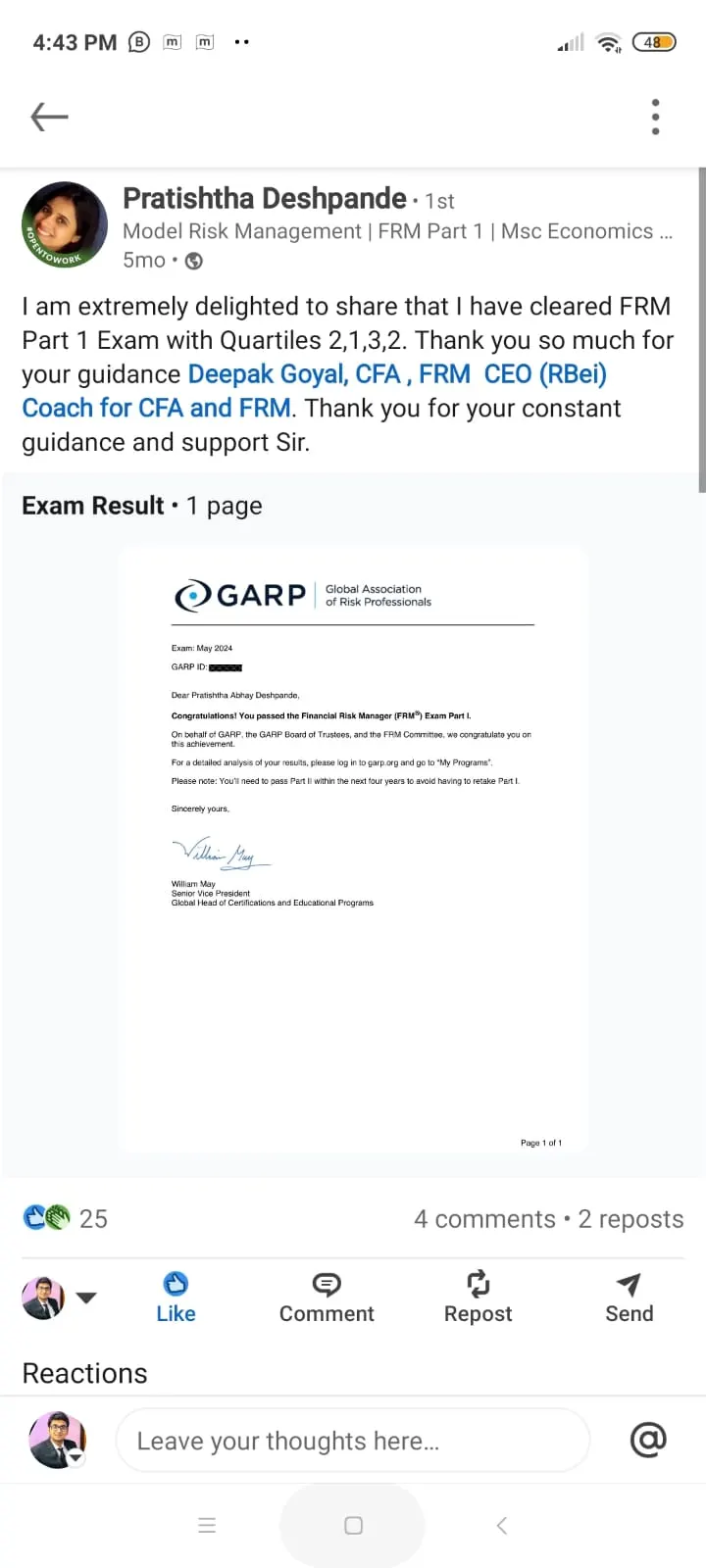
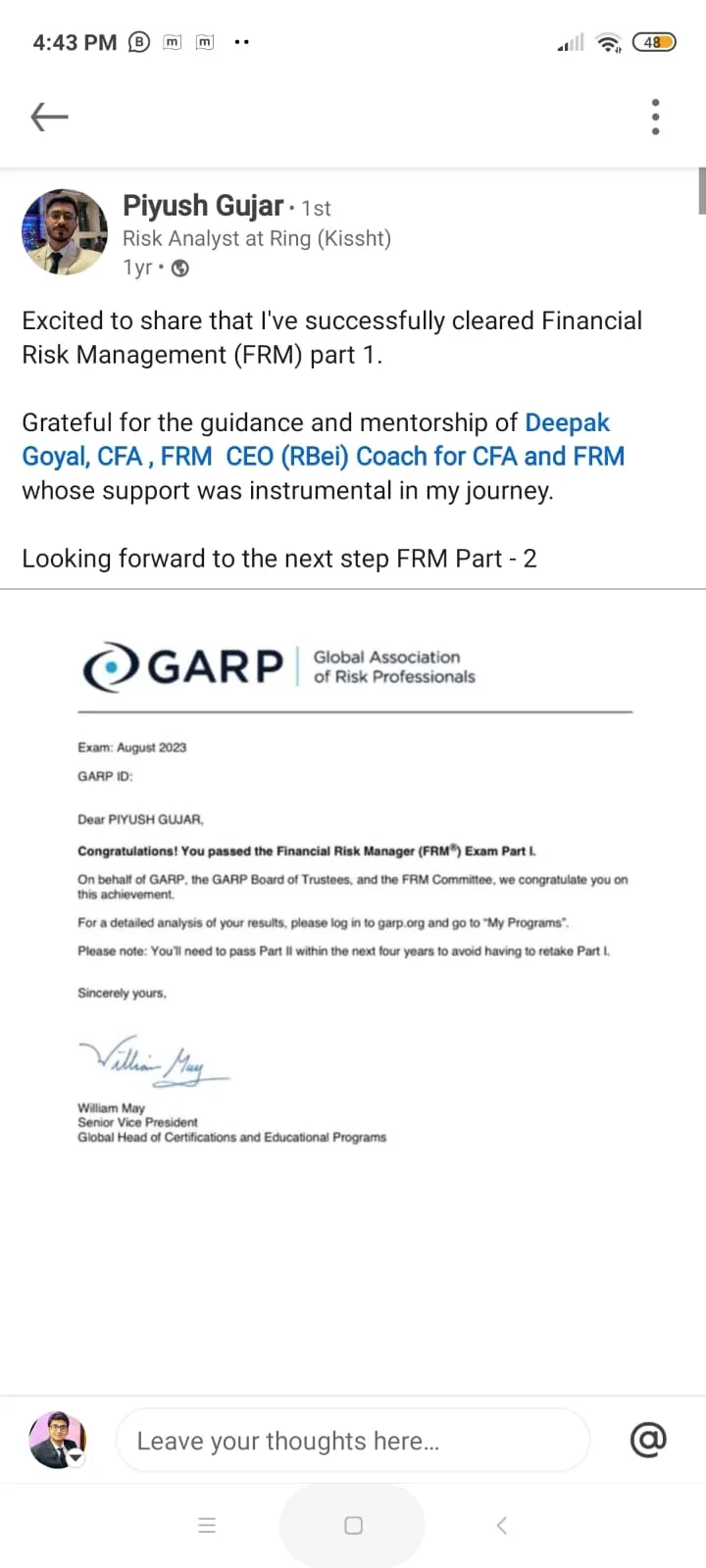
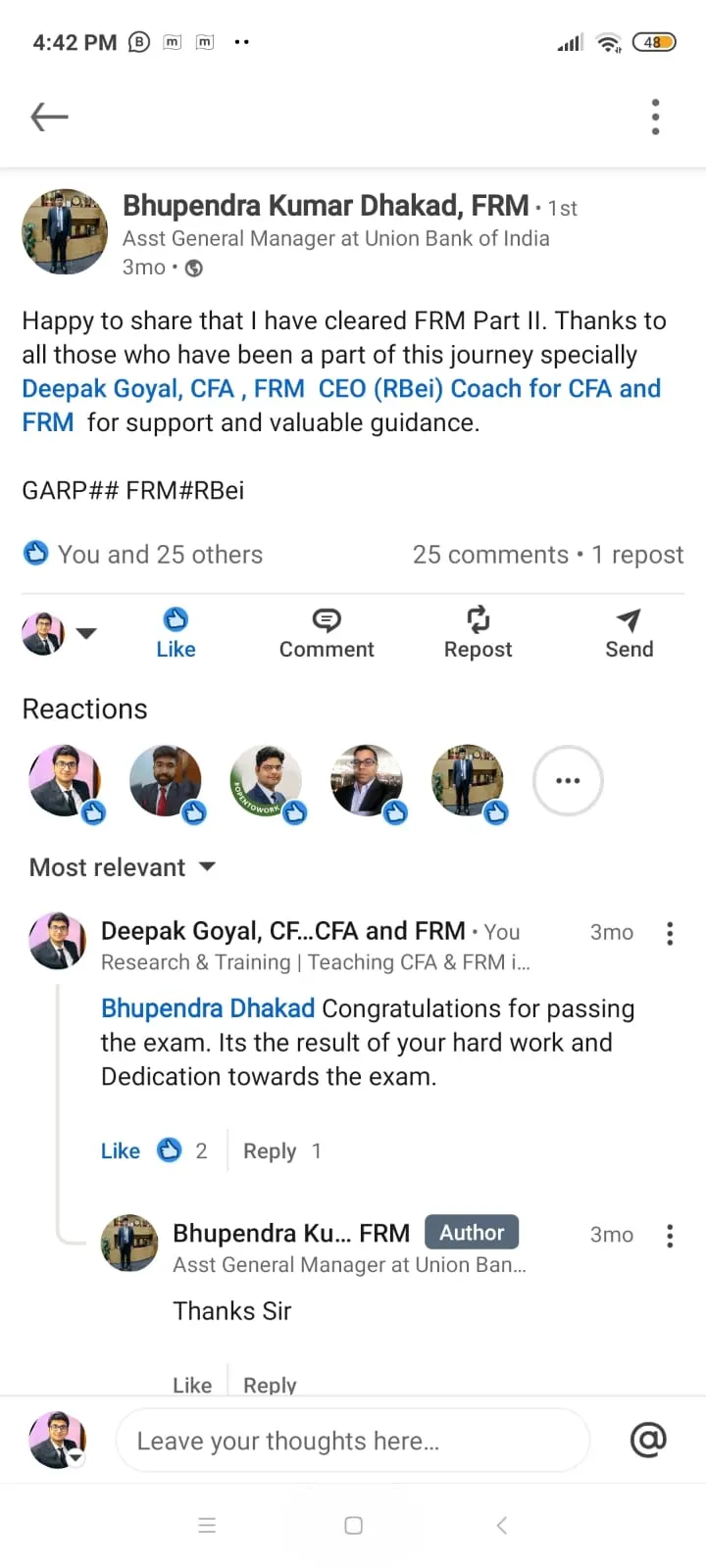
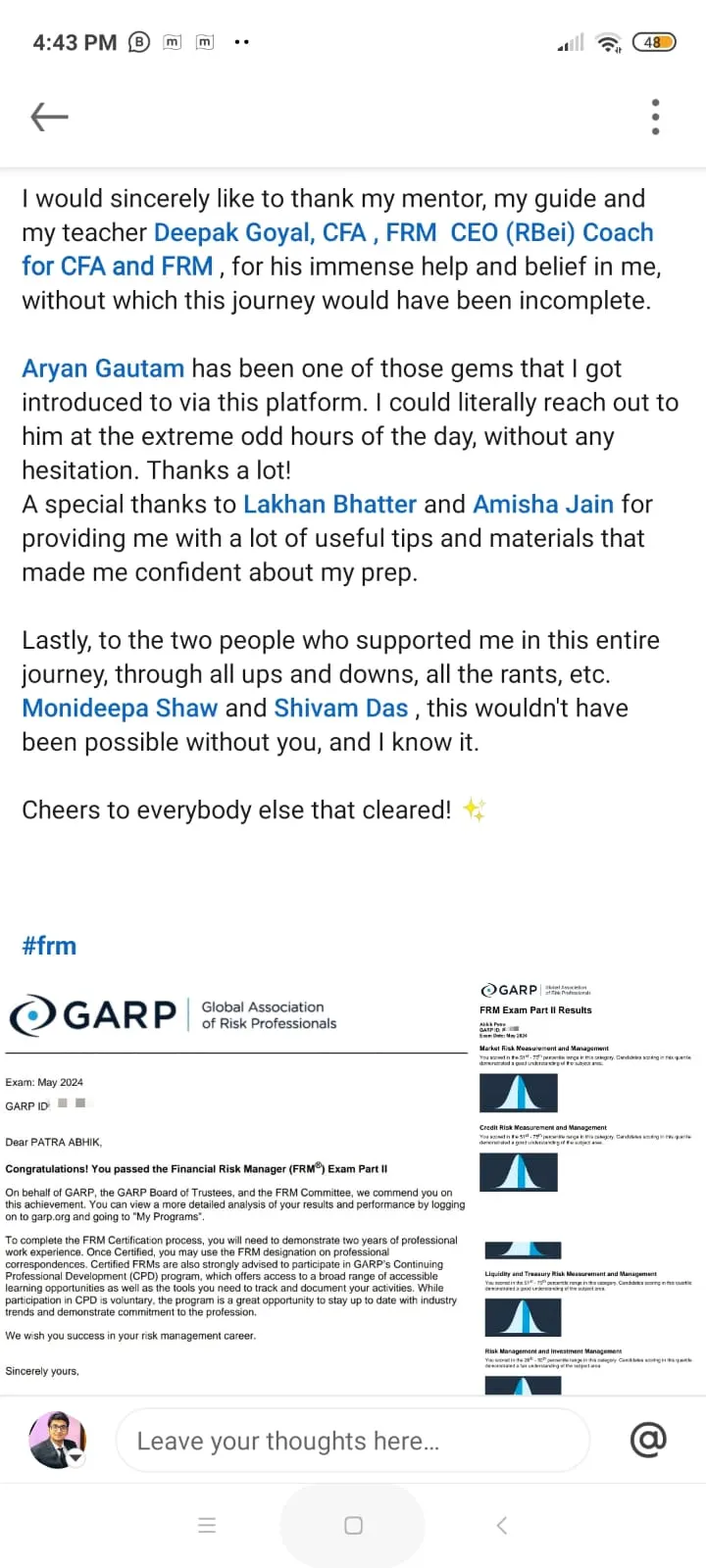
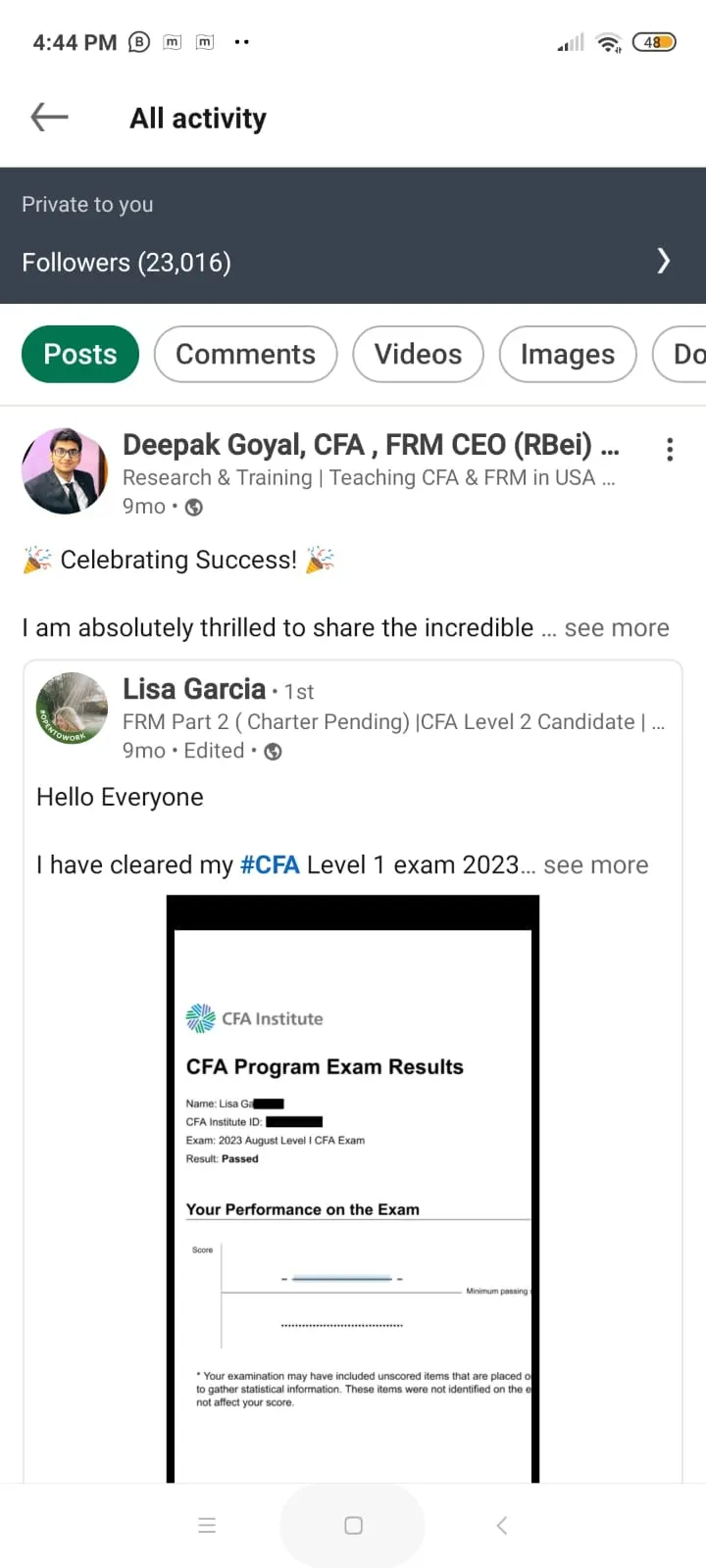
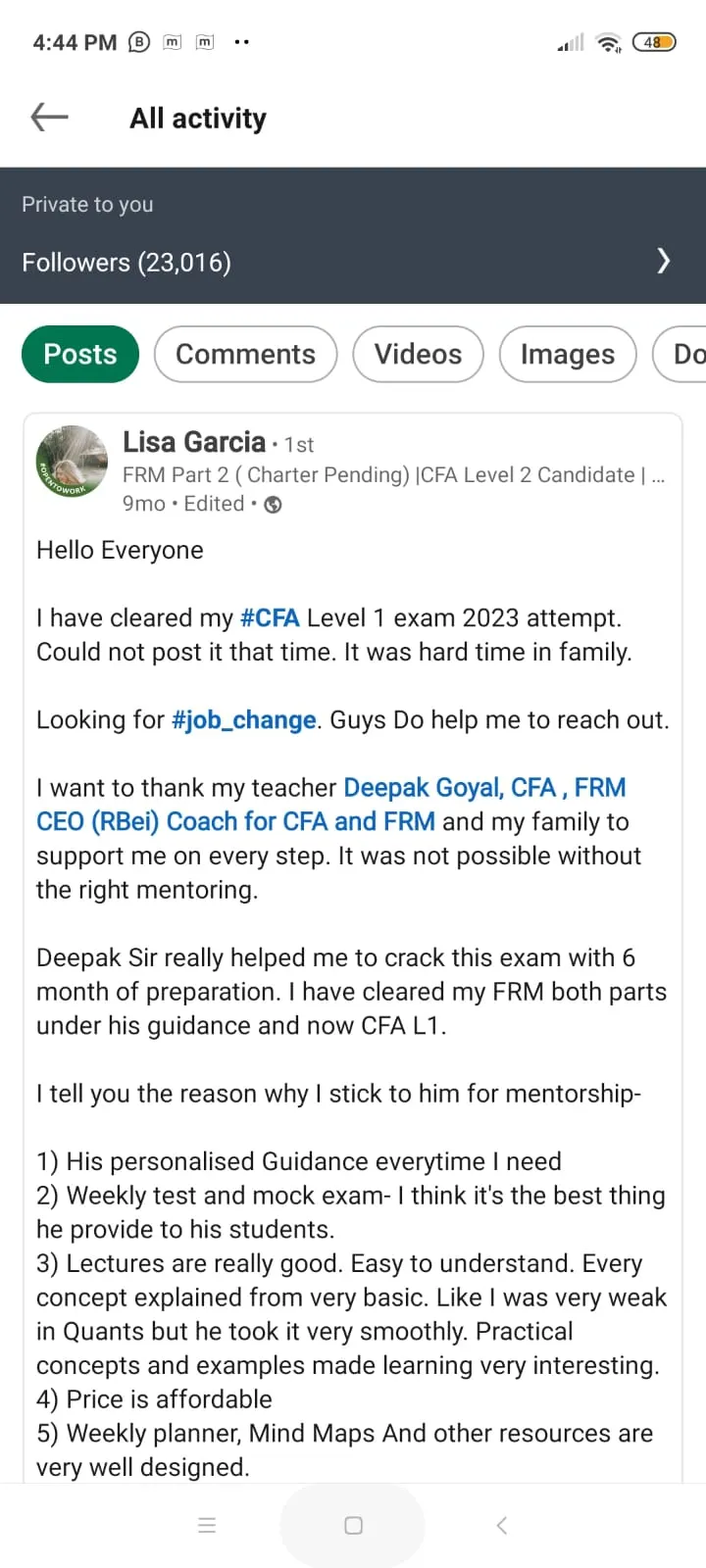
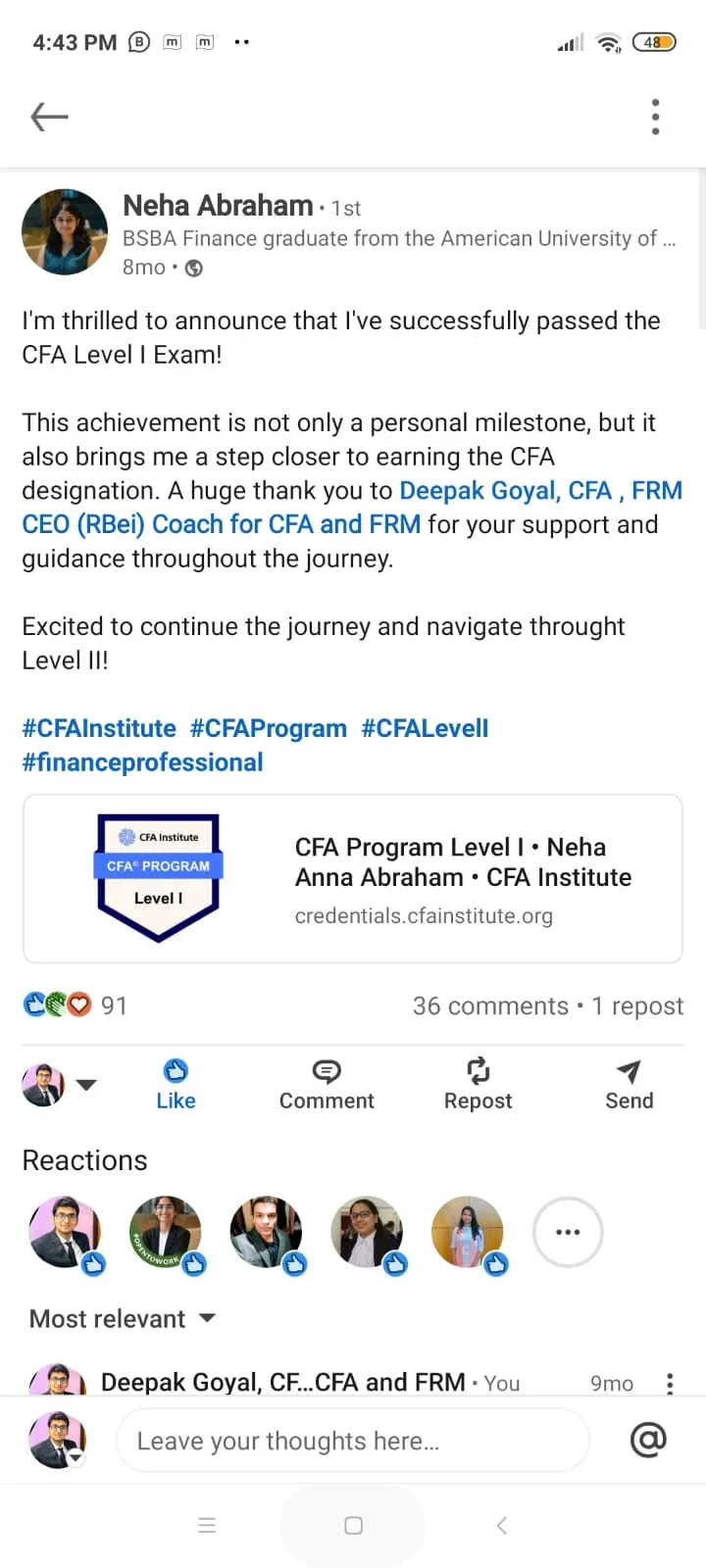
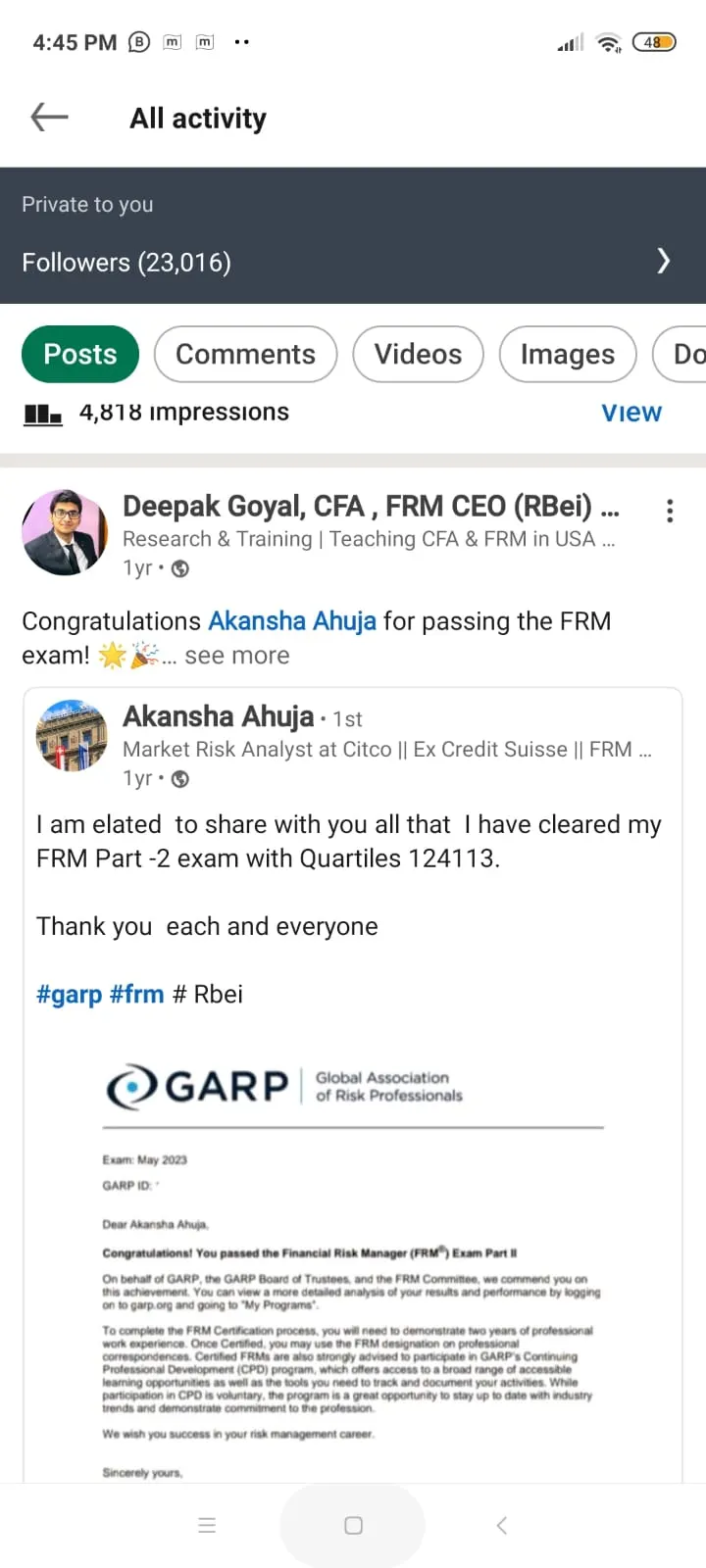
results publicly on LinkedIn. The 13 posts below are a sample of RBei Classes students
announcing verified CFA and FRM passes — public, name-attributed proof of outcomes.
Key Takeaways
RBei Classes students publicly share verified CFA and FRM results on LinkedIn, with name and profile attached.
The 13 posts shown are a sample of the thousands of students trained by RBei Classes since 2018.
Outcomes span CFA Level 1, CFA Level 2 prep, and FRM Part 1 & 2.
Coaching is led by Deepak Goyal, CFA & FRM charterholder, founder of RBei Classes.
Last updated: June 2026 ·
Reviewed by: Deepak Goyal, CFA & FRM charterholder, founder of RBei Classes ·
Public LinkedIn posts shared by RBei Classes students.
Verified Student Feedback
RBei Classes Reviews — Verified FRM & CFA Student Results
RBei Classes, an FRM & CFA coaching institute founded in 2018 by Deepak Goyal
(CFA & FRM charterholder), has trained thousands of students since 2018 and holds a
4.9 / 5 aggregate rating across review platforms. The five WhatsApp
screenshots below are a small sample of unedited student messages, confirming passes in
CFA Level 1 and FRM Part 2 between March 2023 and April 2024.
★★★★★4.9/5Aggregate rating across review platforms
Neha Anna · Passed CFA Level 1 · Apr 2024
Gilles · Cleared CFA Level 1 · Jan 2024
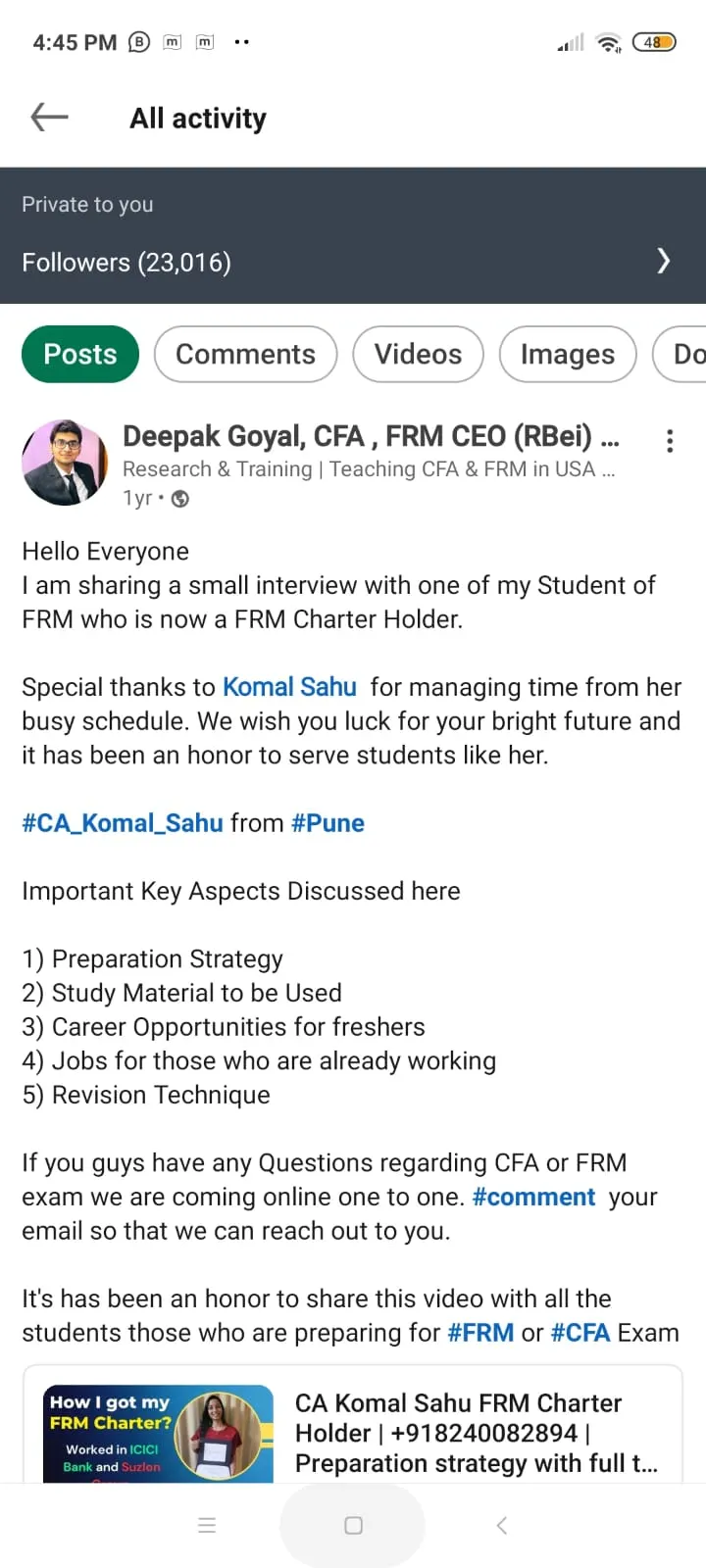
Anjali Sawa · Passed FRM Part 2
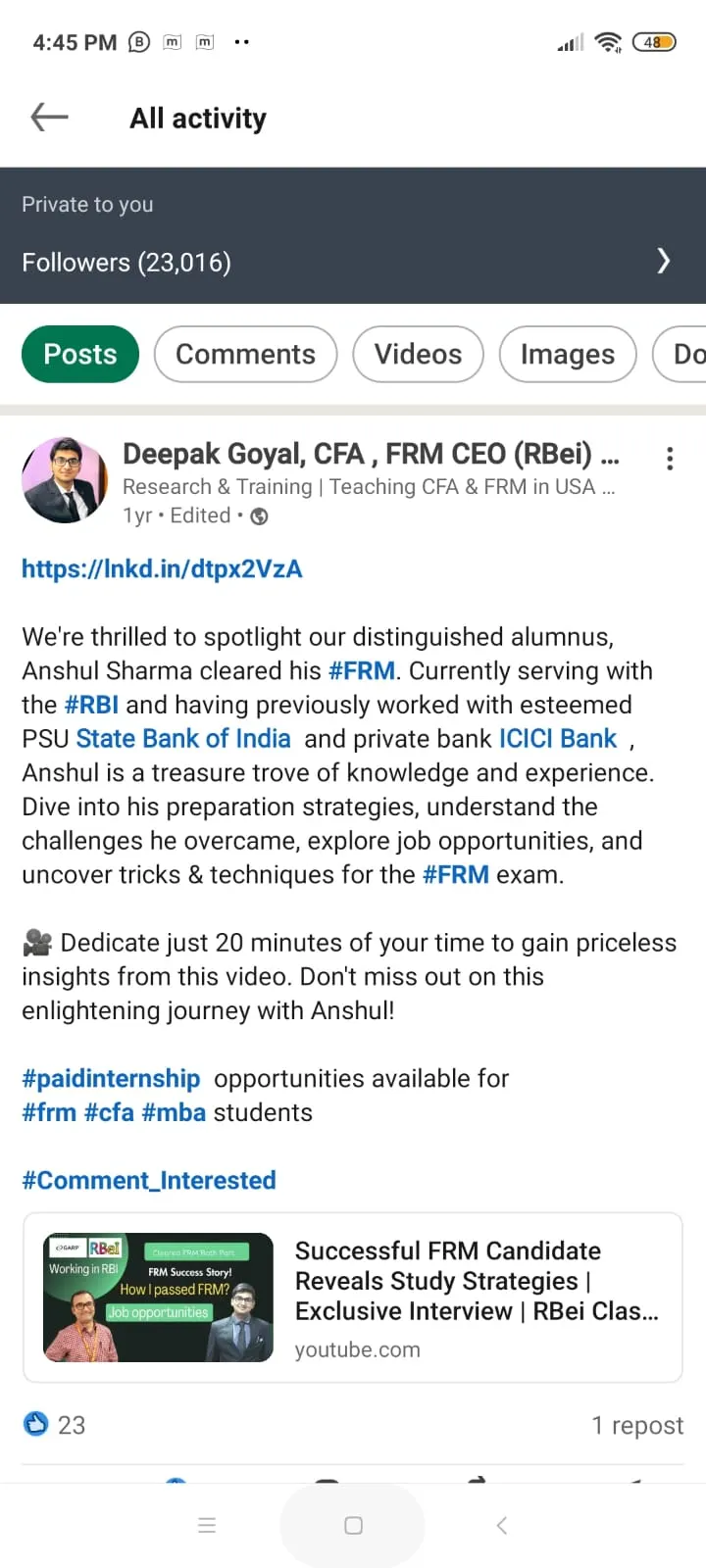
Anshul Sharma · Cleared FRM Part 2 · Aug 2023
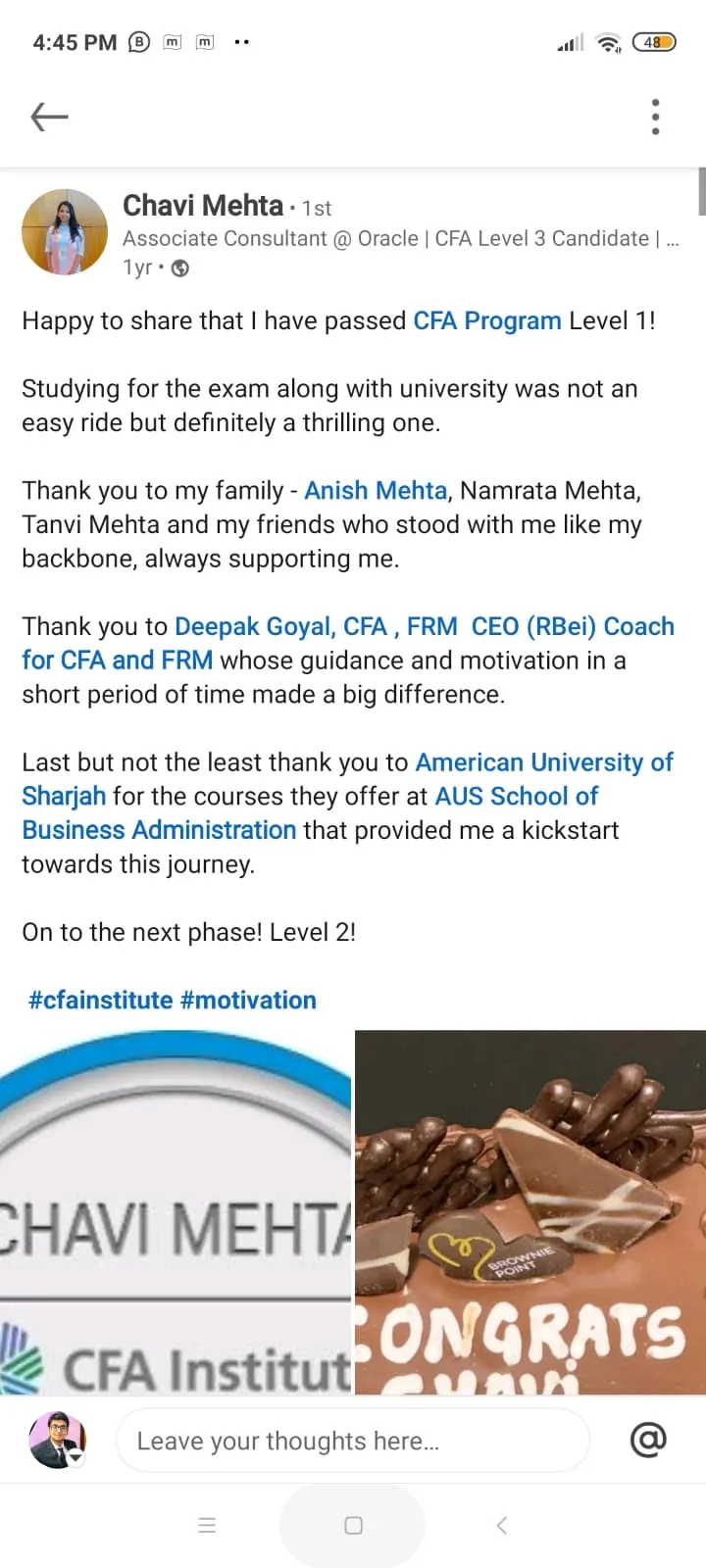
Chavi Mehta · Passed CFA Level 1 · Mar 2023
Key Takeaways
RBei Classes has trained thousands of students since 2018 and holds a 4.9/5 aggregate rating across review platforms.
Verified students cleared CFA Level 1, CFA Level 2 prep, and FRM Part 1 & 2 between 2018 and 2026.
All reviews are unedited WhatsApp messages shared with student consent.
Coaching is led by Deepak Goyal, CFA & FRM charterholder, founder of RBei Classes.
Last updated: June 2026 ·
Reviewed by: Deepak Goyal, CFA & FRM charterholder, founder of RBei Classes ·
Screenshots shared with student consent.
Alumni Success
RBei Classes Alumni Success Stories
Verified RBei Classes alumni working in risk and banking roles across India.
★★★★★
Sunil Tandon
Chief Risk Officer, Punjab & Sind Bank
FRM cleared with RBei Classes
“I cleared the FRM exam with the help of RBei Classes. The concepts were explained so clearly that even difficult topics started making sense. The classes gave me the confidence I needed for the exam.”
“What helped me the most was the doubt-solving support at RBei Classes. Whenever I got stuck, my questions were answered quickly and clearly. That guidance played a big role in helping me clear the FRM exam.”
“The study material provided by RBei Classes was concise and exam-focused. Instead of spending time on unnecessary content, I could focus on what really mattered for the FRM exam and eventually pass.”