CFA & FRM Coaching by Industry Experts | RBei Classes India
🎉 New CFA & FRM batches starting — Reserve your seat →
GARP Official • Updated 2026

FRM Syllabus 2026 — Complete Part 1 & Part 2 Guide

Full topic-wise weights, chapter breakdown, learning objectives, 2026 changes, recommended study hours & expert preparation strategy — curated by Deepak Goyal, CFA & FRM Charterholder.

Based on GARP official curriculum
17,000+ students trained
Get Free FRM Course Details
Sent instantly on WhatsApp & Email
Please call +91 8583905853

100% free • No spam • Call +91 8583905853

Quick Answer

The FRM 2026 syllabus covers Part 1 (4 topics: Foundations 20%, Quantitative Analysis 20%, Financial Markets 30%, Valuation & Risk Models 30%) and Part 2 (6 topics: Market Risk 20%, Credit Risk 20%, Operational Risk 20%, Liquidity Risk 15%, Investment Risk 15%, Current Issues 10%). The same curriculum applies to May, August, and November 2026 exams. Published annually by GARP.

FRM Program Overview

What Is the FRM Syllabus 2026? Official GARP Curriculum Guide

The FRM (Financial Risk Manager) syllabus is the official curriculum published annually by the Global Association of Risk Professionals (GARP) for the FRM certification exam. For 2026, GARP has maintained the same two-part structure with minor updates primarily in Part 2.

The FRM exam is the world's most respected risk management certification, covering every dimension of financial risk — from Value at Risk (VaR) and Expected Shortfall to Credit Default Swaps (CDS), Counterparty Value Adjustment (CVA), and operational risk frameworks. The curriculum is divided into FRM Part 1 (foundational tools) and FRM Part 2 (applied risk management).

The 2026 syllabus applies to all three exam windows — May, August, and November. This means students targeting August or November 2026 follow the exact same curriculum. GARP officially releases the Study Guide and learning objectives at the start of each calendar year.

This page covers the complete, official FRM 2026 syllabus in detail — every topic, every chapter, all exam weights, recommended study hours, the 2026 changes, and an expert preparation strategy by Deepak Goyal, CFA & FRM Charterholder — one of India's most experienced FRM educators. See also: FRM Coaching Plans, FRM Career Opportunities, and CFA Syllabus 2026.

📄 FRM 2026 — Quick Facts

Conducted by
GARP (Global Association of Risk Professionals)
Parts
Part 1 + Part 2 (sequential)
Part 1 format
100 MCQs • 4 hours • Computer-based
Part 2 format
80 MCQs • 4 hours • Computer-based
Part 1 weights
FRM 20% / QA 20% / FMP 30% / VRM 30%
Part 2 weights
Market 20% / Credit 20% / OpRisk 20% / Liquidity 15% / InvRisk 15% / Current 10%
Exam windows
May / August / November each year
Aug 2026 deadline
June 30, 2026
Nov 2026 deadline
Early: July 31 • Standard: Sept 30
Enrollment fee
USD 400 (one-time, new candidates)
Exam fee
USD 600 (early) / USD 800 (standard)
Study hours
~240 hrs Part 1 • ~240 hrs Part 2
Global pass rate
~44% Part 1 • ~58% Part 2
RBei pass rate
93% — 2× global average
Eligibility
None — open to all backgrounds
FRM Part 1 Syllabus 2026

FRM Part 1 Syllabus 2026 — Complete Topic & Weight Breakdown

Official GARP FRM Part 1 syllabus — 4 topics, 100 MCQs, 4 hours. Same topic weights apply for May, August & November 2026

FRM Part 1 — 2026 Exam Overview

Focus: Foundational risk tools — quantitative analysis, financial markets, and basic risk models

100
MCQs
4
Hours
4
Topics
~240
Study Hrs

Topic Weight Distribution — FRM Part 1 2026

This section establishes the conceptual and governance framework for risk management. It covers why risk management creates value, how organisations structure their risk functions, and real-world lessons from financial disasters. Despite appearing qualitative, GARP asks analytical, judgment-based questions that require evaluating governance decisions and understanding case study lessons — not just memorising definitions.

  • The Building Blocks of Risk Management
  • How Do Firms Manage Financial Risk?
  • The Governance of Risk Management
  • Credit Risk Transfer Mechanisms
  • Modern Portfolio Management and the Capital Asset Pricing Model (CAPM)
  • The Arbitrage Pricing Theory and Multifactor Models of Risk
  • Risk-Adjusted Performance Measurement (RAPM)
  • Enterprise Risk Management (ERM) and Future Trends
  • Learning from Financial Disasters (LTCM, Barings, Orange County, Global Financial Crisis)
  • Anatomy of the Great Financial Crisis of 2007–2009
  • GARP Code of Conduct and Professional Standards
  • Data Aggregation and Risk Reporting
Deepak Sir's Insight: Most candidates underweight this section. The case studies (LTCM, Barings Bank, Global Financial Crisis) appear in every exam. Understand the specific risk failures — not just what happened, but why the risk framework failed.

This topic covers the mathematical and statistical foundations that underpin every risk measurement technique in the FRM curriculum. For 2026, two chapters have been updated — Hypothesis Testing and Stationary Time Series — with 6 learning outcome statements revised to emphasize applied calculation and scenario interpretation. These changes slightly increase the probability of numerical-based questions in these areas.

  • Fundamentals of Probability
  • Random Variables and Probability Distributions
  • Common Univariate Random Variables
  • Multivariate Random Variables and Copulas
  • Sample Moments and Properties
  • Hypothesis Testing (Updated 2026 — 1 LOS revised)
  • Linear Regression: Single Factor Models
  • Linear Regression: Multiple Factors Models
  • Regression Diagnostics and Modelling Issues
  • Stationary Time Series (Updated 2026 — 5 LOS revised)
  • Non-Stationary Time Series
  • Measuring Returns, Volatility, and Correlation
  • Simulation and Bootstrapping
  • Machine Learning Methods (Overview)
2026 Change Alert: The 2026 updates in Hypothesis Testing and Stationary Time Series shift emphasis toward applied interpretation and calculation — expect more numerical scenario-based questions in these areas compared to 2025.

This is the most calculation-intensive section of FRM Part 1 and carries the highest weight alongside Valuation & Risk Models. It covers the full range of financial instruments — equities, bonds, derivatives, FX, and securitised products — along with their pricing, risk characteristics, and real-world applications. Deep understanding of derivatives (options, futures, swaps, forwards) is essential here.

  • Introduction to Derivatives
  • Exchanges, OTC Markets, and Clearing Houses
  • Forward and Futures Contracts: Pricing and Valuation
  • Hedging with Futures and Forward Contracts
  • Interest Rate Futures
  • Swaps: Interest Rate, Currency, Equity & Credit
  • Options on Futures and Exchange-Traded Options
  • Properties of Options: Bounds and Put-Call Parity
  • Trading Strategies Using Options
  • Exotic Options
  • Properties of Interest Rates: Term Structure
  • Fixed Income Securities: Bond Pricing and Duration
  • Fixed Income Securities: Convexity and DV01
  • Mortgages and Mortgage-Backed Securities (MBS)
  • Foreign Exchange Risk and FX Forwards
  • Introduction to Commodities and Commodity Markets
  • Structured Credit Products: CDOs and CLOs
Deepak Sir's Insight: Derivatives pricing and hedging strategies are the highest-yield areas in this section. Master forwards, futures, swaps, and options — know how to price them from scratch without formula sheets.

This section bridges financial instrument valuation with quantitative risk measurement. It introduces the core risk measurement tools that are applied extensively throughout Part 2 — VaR, Expected Shortfall, Greeks, credit risk models, and operational risk frameworks. This is the most technically demanding section of Part 1 and connects directly to Part 2 topics.

  • Measures of Financial Risk: VaR and Expected Shortfall (ES)
  • Estimating Market Risk Measures: Historical Simulation
  • Estimating Market Risk Measures: Parametric Methods
  • Estimating Volatility and Correlation
  • Operational Risk: Definition and Approaches
  • Pricing Conventions, Discounting, and Arbitrage
  • Interest Rate Risk in the Banking Book (IRRBB)
  • Hedging with Interest Rate Futures and Duration
  • Binomial Trees for Option Pricing
  • The Black-Scholes-Merton (BSM) Model
  • The Greek Letters: Delta, Gamma, Vega, Theta, Rho
  • Options on Stock Indices, Currencies, and Futures
  • Bonds: Spot Rates, Duration, and Convexity
  • Introduction to Credit Risk: PD, LGD, EAD
  • Country and Sovereign Risk Models
Deepak Sir's Insight: Master VaR and Expected Shortfall thoroughly — the difference between parametric, historical, and Monte Carlo VaR is a favourite exam topic. The Black-Scholes model and option Greeks generate the most calculation questions in this section.
Prepare FRM Part 1 with Deepak Sir →
FRM Part 2 Syllabus 2026

FRM Part 2 Syllabus 2026 — Complete Topic & Weight Breakdown

Official GARP FRM Part 2 syllabus — 6 topics, 80 MCQs, 4 hours. Same topic weights apply for May, August & November 2026

FRM Part 2 — 2026 Exam Overview

Focus: Applied risk management — market, credit, operational, liquidity, investment & current issues

80
MCQs
4
Hours
6
Topics
~240
Study Hrs

Topic Weight Distribution — FRM Part 2 2026

This section extends Part 1 VaR and risk models to advanced market risk measurement at the professional level. It covers sophisticated VaR methodologies, backtesting, stress testing, the Basel regulatory capital framework for market risk, and the full suite of Greeks and options risk management. Heavy emphasis on regulatory requirements (Basel III/IV) and practical implementation.

  • Estimating Market Risk Measures: An Introduction
  • Non-Parametric Approaches to Market Risk Estimation
  • Parametric Approaches to Market Risk Estimation
  • Backtesting VaR
  • VaR Mapping
  • ES and Stressed Metrics (Basel III/IV)
  • The Science of Term Structure Models
  • The Evolution of Short Rate Models
  • Volatility Smiles and Volatility Term Structure
  • Exotic Options and Structured Products
  • Fundamental Review of the Trading Book (FRTB)
  • Stress Testing Banks
  • Principles for Sound Stress Testing Practices

Credit risk is the most mathematically demanding section of Part 2, covering credit models, counterparty risk, credit derivatives, structured products, and regulatory requirements. It requires deep understanding of default probability models, credit portfolio analytics, and the mechanics of CDOs, CLOs, and credit default swaps.

  • Credit Risk Measurement and Management
  • Fundamentals of Credit Analysis
  • Country Risk: Determinants, Measurement, and Implications
  • Spread Risk and Default Intensity Models
  • Portfolio Credit Risk
  • Structured Credit Risk: CDOs and CLOs
  • Counterparty Credit Risk (CCR): Overview
  • Netting, Close-out, Rehypothecation, and Margin
  • Credit Value Adjustment (CVA) and DVA
  • Credit Derivatives: CDS, Total Return Swaps
  • Credit Scoring and Retail Credit Risk
  • Expected Loss, Unexpected Loss and Economic Capital
  • Regulatory Capital for Credit Risk (Basel III/IV)
Deepak Sir's Insight: CVA, DVA and counterparty credit risk are the most frequently tested advanced topics. Understand the full credit lifecycle — from origination and PD/LGD/EAD measurement through to credit derivatives and structured products.

Operational risk covers non-financial risks arising from processes, people, systems, and external events. For 2026, this section is largely unchanged from 2025. It focuses on the identification, measurement, and management of operational risk under Basel regulatory frameworks, including governance requirements, risk data collection, scenario analysis, and business continuity frameworks.

  • Operational Risk: Definition, Principles and Concepts
  • Basel III Operational Risk Frameworks and Capital Charge
  • The Standardised Measurement Approach (SMA)
  • Operational Risk Governance and Risk Culture
  • Risk and Control Self-Assessment (RCSA)
  • Key Risk Indicators (KRIs) and Metrics
  • Loss Data Collection and Severity Modelling
  • Scenario Analysis for Operational Risk
  • Model Risk and Validation
  • Cyber Risk and Information Security Risk
  • Conduct Risk and Culture
  • Business Continuity Planning (BCP)
  • Resilience and Third-Party Risk

This section covers the measurement and management of funding liquidity risk and market liquidity risk, as well as treasury management in banking institutions. The LCR, NSFR, and asset-liability management (ALM) frameworks under Basel III are core exam areas.

  • Liquidity Risk: Definitions and Fundamentals
  • Funding and Liquidity Risk in Banks
  • Liquidity Coverage Ratio (LCR) — Basel III
  • Net Stable Funding Ratio (NSFR) — Basel III
  • Contingency Funding Planning (CFP)
  • Intraday Liquidity Risk
  • Market Liquidity and Liquidity-Adjusted VaR
  • Asset-Liability Management (ALM) — Fundamentals
  • Interest Rate Risk in the Banking Book (IRRBB)
  • Transfer Pricing of Funds
  • Liquidity Stress Testing

This section applies risk management frameworks to investment portfolios — covering portfolio risk measurement, hedge fund risk, factor models, and performance attribution. For 2026, GARP has introduced significant updates including deeper coverage of model validation, private markets risk analytics, and hedge fund strategy risk.

  • Factor Theory and Factor Models
  • Portfolio Construction
  • Portfolio Risk: Analytical Methods
  • VaR and Risk Budgeting in Investment Management
  • Risk Monitoring and Performance Measurement
  • Portfolio Performance Evaluation (Sharpe, Treynor, Jensen)
  • Hedge Funds: Overview and Risk Characteristics
  • Hedge Fund Strategies and Risk (Updated 2026)
  • Model Validation Frameworks (Updated 2026)
  • Private Markets and Alternative Investment Risk (Updated 2026)
  • Risk Management for Pension Funds and Insurance
2026 Update: Hedge fund strategy risk, model validation, and private markets have been updated with deeper analytical requirements. Expect more nuanced application questions in these areas compared to 2025.

Current Issues is the section that changes most each year. GARP updates it to reflect emerging risks and contemporary challenges in financial markets. For 2026, the updates are significant — with heavy additions around AI in finance, stress scenario generation, systemic risk from interconnectedness, and emerging regulatory developments. Candidates using 2025 study materials will have gaps in this section.

  • Artificial Intelligence and Machine Learning in Risk Management (New/Updated 2026)
  • Scenario Generation and Advanced Stress Testing (New/Updated 2026)
  • Systemic Risk and Interconnectedness
  • Climate Risk and ESG in Financial Institutions
  • Digital Assets, Crypto and Blockchain Risk
  • Cyber Risk: Systemic Implications
  • Regulatory Developments: Basel IV and Beyond
  • Geopolitical Risk and Country Risk Dynamics
  • Stress Testing: Regulatory and Internal Frameworks
Important for 2026: Do NOT use 2024 or older study materials for this section. GARP significantly changed Current Issues for 2026 — AI in finance and scenario generation are entirely new areas. Use GARP's official 2026 readings or updated coaching materials.
Prepare FRM Part 2 with Deepak Sir →
2026 Updates

FRM Syllabus 2026 Changes — What Is New vs 2025

Exact 2026 FRM syllabus changes topic-by-topic — Part 1 updates and Part 2 updates compared to 2025

✓ Unchanged

FRM Part 1 — Foundations of Risk Management

No changes for 2026. The fundamental risk frameworks, case studies, CAPM, multifactor models, ERM and GARP Code of Conduct remain exactly the same. Students using 2025 materials for this section are fully covered.

⚠ Minor Update

FRM Part 1 — Quantitative Analysis

Hypothesis Testing: 1 LOS revised — shift toward applied interpretation and scenario-based questions rather than pure memorisation. Stationary Time Series: 5 LOS revised — verbs updated to include calculation and application. No new chapters added. No chapters deleted. The overall number of chapters remains 62 for Part 1.

✓ Unchanged

FRM Part 1 — Financial Markets & Products

No major changes for 2026. Core frameworks for derivatives, fixed income, FX, and structured products remain the same. Continue to master instrument pricing and hedging mechanics.

✓ Unchanged

FRM Part 1 — Valuation & Risk Models

No changes to core valuation techniques, VaR, Expected Shortfall, option pricing (BSM, binomial trees), or Greeks for 2026. This section is fully stable year-over-year.

✓ Unchanged

FRM Part 2 — Market Risk & Operational Risk

Both Market Risk Measurement and Operational Risk & Resilience sections are largely unchanged for 2026. Core regulatory frameworks (Basel, FRTB), VaR methodologies, and operational risk measurement remain the same.

⚠ Updated

FRM Part 2 — Risk & Investment Management

Significant 2026 updates: deeper coverage of hedge fund strategy risk, new/updated content on model validation frameworks, and expanded private markets risk analytics. Candidates must use 2026 materials for this section — 2025 materials miss these additions.

✓ Stable

FRM Part 2 — Credit Risk & Liquidity Risk

Credit Risk Measurement and Liquidity & Treasury Risk sections are stable for 2026. Core credit models (PD/LGD/EAD, CVA, CDO structures) and liquidity frameworks (LCR, NSFR, ALM) continue without significant changes.

🚨 Major Updates

FRM Part 2 — Current Issues in Financial Markets

Most significantly updated section for 2026. New and heavily revised content covers: AI and ML in risk management, advanced scenario generation and stress testing, digital assets and crypto risk, geopolitical risk dynamics, and ESG in financial institutions. Using 2024 or earlier materials for this section will leave critical gaps.

Exam Structure

FRM 2026 Exam Pattern & Registration Fees

Everything you need to know about the exam format, dates, and GARP fees

📋 Exam Format Comparison

ParameterPart 1Part 2
Number of questions100 MCQs80 MCQs
Duration4 hours4 hours
FormatComputer-based (CBT)Computer-based (CBT)
Question typeMultiple-choice onlyMultiple-choice only
Formula sheetNot providedNot provided
Calculator allowedYes (GARP-approved)Yes (GARP-approved)
Negative markingNoNo
Exam windowsMay / Aug / NovMay / Aug / Nov
Same-day ruleMust pass Part 1 first
Global pass rate~44%~58%

💰 GARP Registration Fees 2026

Fee ComponentUSD~INR
Enrollment fee (new, one-time)$400~₹33,600
Per exam — Early registration$600~₹50,400
Per exam — Standard registration$800~₹67,200
Both parts (early, first-time)~$1,600~₹1,34,400
Both parts (standard, first-time)~$2,000~₹1,68,000

INR approximate at 1 USD = ₹84. Fees verified against GARP's 2026 fee schedule. Always confirm final amounts at garp.org/frm/fees-payments

📅 FRM 2026 Exam Dates

WindowExam DatesEarly RegistrationStandard DeadlineResults
May 2026May 2026 (concluded)Jan 31, 2026Mar 31, 2026~8 weeks after
August 2026 ▶August 7–8, 2026Not offeredJune 30, 2026~8 weeks after
November 2026 ▶November 14–20, 2026July 31, 2026September 30, 2026~8 weeks after
Study Planning

FRM 2026 Study Hours — Topic-Wise Recommended Hours

Recommended study hours per topic — based on GARP guidance and RBei student data

FRM Part 1 — Study Hours by Topic

50–60
Hours
Financial Markets & Products
Heaviest calculation workload — derivatives and instruments
50–60
Hours
Valuation & Risk Models
BSM, Greeks, VaR — demands lots of numerical practice
40–50
Hours
Quantitative Analysis
Time series and regression require regular practice
30–40
Hours
Foundations of Risk Management
More conceptual but case studies need deep understanding
~240
Total Hours
FRM Part 1
GARP-recommended minimum (source: candidate surveys)

FRM Part 2 — Study Hours by Topic

45–55
Hours
Market Risk Measurement
Advanced VaR, FRTB, backtesting — builds on Part 1
45–55
Hours
Credit Risk Measurement
Hardest section — CVA, structured credit, portfolio models
35–45
Hours
Operational Risk & Resilience
Governance, Basel frameworks, model risk
30–35
Hours
Liquidity & Treasury Risk
LCR, NSFR, ALM, intraday liquidity
30–35
Hours
Risk & Investment Management
Updated for 2026 — model validation and hedge funds
20–25
Hours
Current Issues 2026
Major 2026 updates — AI, scenario generation, ESG
~240
Total Hours
FRM Part 2
GARP-recommended minimum (source: candidate surveys)
Expert Strategy

FRM 2026 Preparation Strategy — Phase-by-Phase Study Plan

After training 17,000+ students through FRM, here is the preparation framework that consistently delivers our 93% pass rate.

Phase 1 — Foundations (Weeks 1–8)

  • Start with Foundations of Risk Management to understand the why of risk management
  • Complete Quantitative Analysis — this is the mathematical backbone of everything else
  • Do chapter-level practice questions as you finish each topic, not at the end
  • Focus on the 2026 updates in Hypothesis Testing and Stationary Time Series

Phase 2 — Deep Dive (Weeks 9–16)

  • Cover Financial Markets & Products — go deep on derivatives pricing and hedging
  • Master Valuation & Risk Models — VaR, ES, BSM, and Greeks are exam favourites
  • These two sections carry 60% of the Part 1 exam — they deserve 60% of your time
  • Attempt a full mock exam after completing each section

Phase 3 — Mocks and Revision (Weeks 17–20)

  • Take minimum 3 full-length CBT mock exams under timed conditions
  • Analyse every wrong answer — understand why you got it wrong, not just the correct answer
  • Prioritise high-weight topics for final revision: FMP + VRM = 60 questions
  • Use formula sheets and mind maps for last-week revision
Deepak Goyal, CFA and FRM Charterholder — RBei Classes Founder
Deepak Goyal
CFA Charterholder & FRM Charterholder
CFA Institute GARP FRM
Deepak Goyal is one of India's very few professionals to hold both CFA Charterholder and FRM Charterholder designations. He founded RBei Classes in 2018 and personally teaches every FRM session — no junior faculty, no outsourcing. His concept-first, application-driven approach has produced a 93% pass rate against a global average of just 44%.
8+
Yrs Teaching
17K+
Students
93%
Pass Rate
View LinkedIn Profile ↗ Verify FRM Credential at GARP ↗
FAQ

FRM Syllabus 2026 — Frequently Asked Questions

Every question students ask about the FRM 2026 syllabus — answered by Deepak Sir

The FRM 2026 syllabus is published by GARP and divided into two parts. FRM Part 1 covers four topics: Foundations of Risk Management (20%), Quantitative Analysis (20%), Financial Markets & Products (30%), and Valuation & Risk Models (30%) — tested across 100 MCQs in 4 hours. FRM Part 2 covers six topics: Market Risk (20%), Credit Risk (20%), Operational Risk (20%), Liquidity Risk (15%), Risk & Investment Management (15%), and Current Issues (10%) — tested across 80 MCQs in 4 hours. The same 2026 syllabus applies to all three exam windows: May, August, and November.
FRM Part 1 2026 official topic weights from GARP: Financial Markets & Products = 30% (~30 questions), Valuation & Risk Models = 30% (~30 questions), Foundations of Risk Management = 20% (~20 questions), Quantitative Analysis = 20% (~20 questions). Total = 100 questions. Financial Markets & Products and Valuation & Risk Models together account for 60% of the exam and should receive the most study time.
FRM Part 2 2026 official topic weights: Market Risk Measurement & Management = 20% (~16 questions), Credit Risk Measurement & Management = 20% (~16 questions), Operational Risk & Resilience = 20% (~16 questions), Liquidity & Treasury Risk = 15% (~12 questions), Risk Management & Investment Management = 15% (~12 questions), Current Issues in Financial Markets = 10% (~8 questions). Total = 80 questions.
FRM Part 1 changes for 2026 are minor — only two chapters in Quantitative Analysis updated (Hypothesis Testing: 1 LOS revised; Stationary Time Series: 5 LOS revised). No new chapters added or deleted from Part 1. FRM Part 2 changes are more significant: Risk & Investment Management section updated with new content on hedge fund strategies, model validation, and private markets; Current Issues in Financial Markets significantly updated with AI in risk management, scenario generation, digital assets, and ESG topics. Do not use 2024 materials for Part 2 Current Issues.
Yes. GARP confirms that the FRM 2026 syllabus is identical for all three exam windows — May, August, and November 2026. GARP does not change the curriculum mid-year. Candidates targeting any of the three 2026 windows study the exact same topics, weights, and learning objectives. The curriculum changes only at the start of a new calendar year (i.e., 2027 will have its own cycle of changes).
GARP recommends approximately 240 hours for FRM Part 1 and approximately 240 hours for FRM Part 2 — based on their candidate survey data. At RBei Classes, students following Deepak Sir's study planner typically require 4–5 months per part when studying 90 minutes daily on weekdays and 4+ hours on weekends. Most RBei students clear both parts in 10–14 months total, even while working full-time.
Start with Foundations of Risk Management to build conceptual understanding of why risk management matters — this frames everything else. Then move to Quantitative Analysis — the statistical tools you learn here are prerequisites for valuation models. Then tackle Financial Markets & Products and Valuation & Risk Models together, as they reference each other heavily. The final 8 weeks before the exam should focus on mock tests and targeted revision of high-weight topics (FMP + VRM = 60 questions).
The FRM August 2026 exam registration standard deadline is June 30, 2026. There is no early registration discount offered for the August window. The exam itself runs on August 7–8, 2026 (Part 1 morning session). For November 2026, early registration closes July 31, 2026 (USD 600 per part) and standard registration closes September 30, 2026 (USD 800 per part). Always verify current deadlines on GARP's official website.
No. FRM has no educational or professional prerequisites for registration. Anyone — regardless of educational background, field of study, or work experience — can register for and sit FRM Part 1. Engineers, science graduates, commerce students, and working professionals from non-finance fields all successfully clear FRM with the right coaching. The only requirement to receive the FRM designation (after passing both parts) is demonstrating two years of relevant full-time work experience in financial risk or a related field within five years of passing Part 2.
Based on RBei student performance data across 17,000+ students: in Part 1, Valuation & Risk Models — particularly the Black-Scholes model, option Greeks, and VaR calculations — is the most technically demanding. In Part 2, Credit Risk Measurement & Management — specifically CVA/DVA, structured credit products (CDOs/CLOs), and counterparty credit risk — is consistently the hardest section. Both require heavy numerical practice, not just conceptual understanding.
Yes. GARP publishes the official FRM 2026 Study Guide and learning objectives as a PDF at garp.org/frm/study-materials. It is free to download after registering on their site. The Study Guide lists every topic, reading, and learning objective for both Part 1 and Part 2. RBei Classes also provides a condensed syllabus summary PDF to students — fill the form above to receive it on WhatsApp and Email instantly.
The key difference is focus area. The FRM syllabus (GARP) is entirely risk-focused — market risk, credit risk, operational risk, liquidity risk, and risk models. It has 2 parts (100 + 80 MCQs) and takes 12–18 months. The CFA syllabus (CFA Institute) covers investment management broadly — equity research, portfolio management, fixed income, derivatives, economics, and ethics. It has 3 levels and takes 3–5 years. FRM is ideal for risk management careers in banking and finance. CFA is best for investment analysis, portfolio management, and research roles. Deepak Goyal at RBei Classes holds both designations and teaches both — many RBei students pursue both certifications.
Absolutely. The majority of RBei FRM students — over 70% — are working professionals in banking, finance, and IT. The FRM Part 1 syllabus covers 4 topics over approximately 240 hours. With a structured study plan of 90 minutes daily on weekdays and 3–4 hours on weekends, most working professionals clear Part 1 in 4–5 months. RBei Classes specifically offers weekend batches for working professionals, with all sessions recorded and available for lifetime replay. The 2026 syllabus has no major changes from 2025 — making it manageable for even busy professionals with limited study hours.
Start FRM Preparation

Know the Syllabus. Now Master It.

Deepak Goyal personally teaches every topic of the FRM 2026 syllabus at RBei Classes. 93% pass rate. Lifetime access. Weekend batches for working professionals.

View FRM Coaching Plans → 💬 WhatsApp Deepak Sir

FRM Part 1 coaching from ₹15,000 • Both Parts from ₹25,000 • Lifetime access*

Ready to Clear FRM in 2026?

Enroll with Deepak Goyal — India's most trusted FRM coach — and join 17,000+ students who cleared with RBei.

17,000+Students Trained
93%FRM Pass Rate
200+Hours Live Classes
4,000+Practice Questions
8Full Mock Exams
25+Countries
4.9/5Google Rating
Verified on LinkedIn

RBei Classes Student Success on LinkedIn

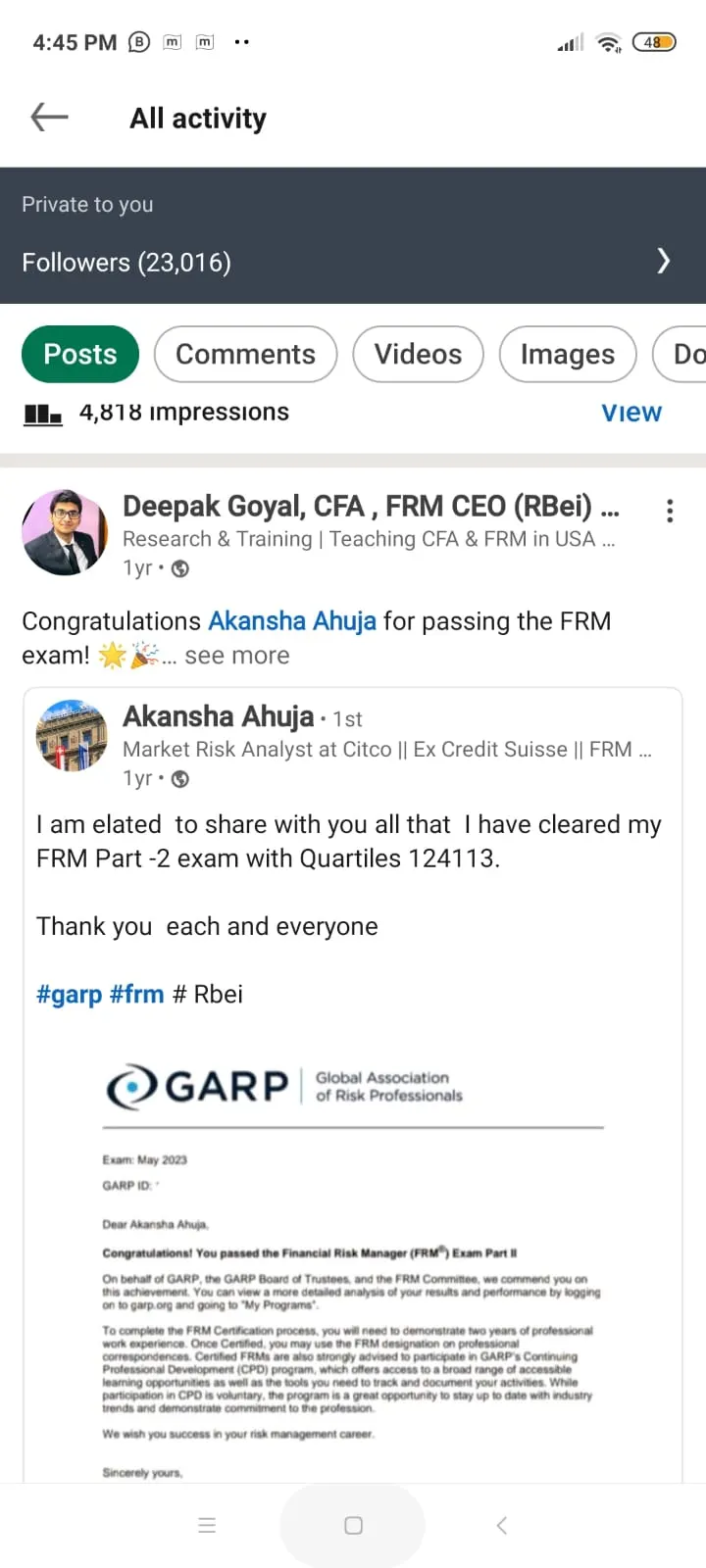
RBei Classes, an FRM & CFA coaching institute founded in 2018 by Deepak Goyal (CFA & FRM charterholder), has trained thousands of students who share their results publicly on LinkedIn. The 13 posts below are a sample of RBei Classes students announcing verified CFA and FRM passes — public, name-attributed proof of outcomes.

Key Takeaways

  • RBei Classes students publicly share verified CFA and FRM results on LinkedIn, with name and profile attached.
  • The 13 posts shown are a sample of the thousands of students trained by RBei Classes since 2018.
  • Outcomes span CFA Level 1, CFA Level 2 prep, and FRM Part 1 & 2.
  • Coaching is led by Deepak Goyal, CFA & FRM charterholder, founder of RBei Classes.

Last updated: June 2026 · Reviewed by: Deepak Goyal, CFA & FRM charterholder, founder of RBei Classes · Public LinkedIn posts shared by RBei Classes students.

Verified Student Feedback

RBei Classes Reviews — Verified FRM & CFA Student Results

RBei Classes, an FRM & CFA coaching institute founded in 2018 by Deepak Goyal (CFA & FRM charterholder), has trained thousands of students since 2018 and holds a 4.5 / 5 aggregate rating across review platforms. The five WhatsApp screenshots below are a small sample of unedited student messages, confirming passes in CFA Level 1 and FRM Part 2 between March 2023 and April 2024.

Key Takeaways

  • RBei Classes has trained thousands of students since 2018 and holds a 4.5/5 aggregate rating across review platforms.
  • Verified students cleared CFA Level 1, CFA Level 2 prep, and FRM Part 1 & 2 between 2018 and 2026.
  • All reviews are unedited WhatsApp messages shared with student consent.
  • Coaching is led by Deepak Goyal, CFA & FRM charterholder, founder of RBei Classes.
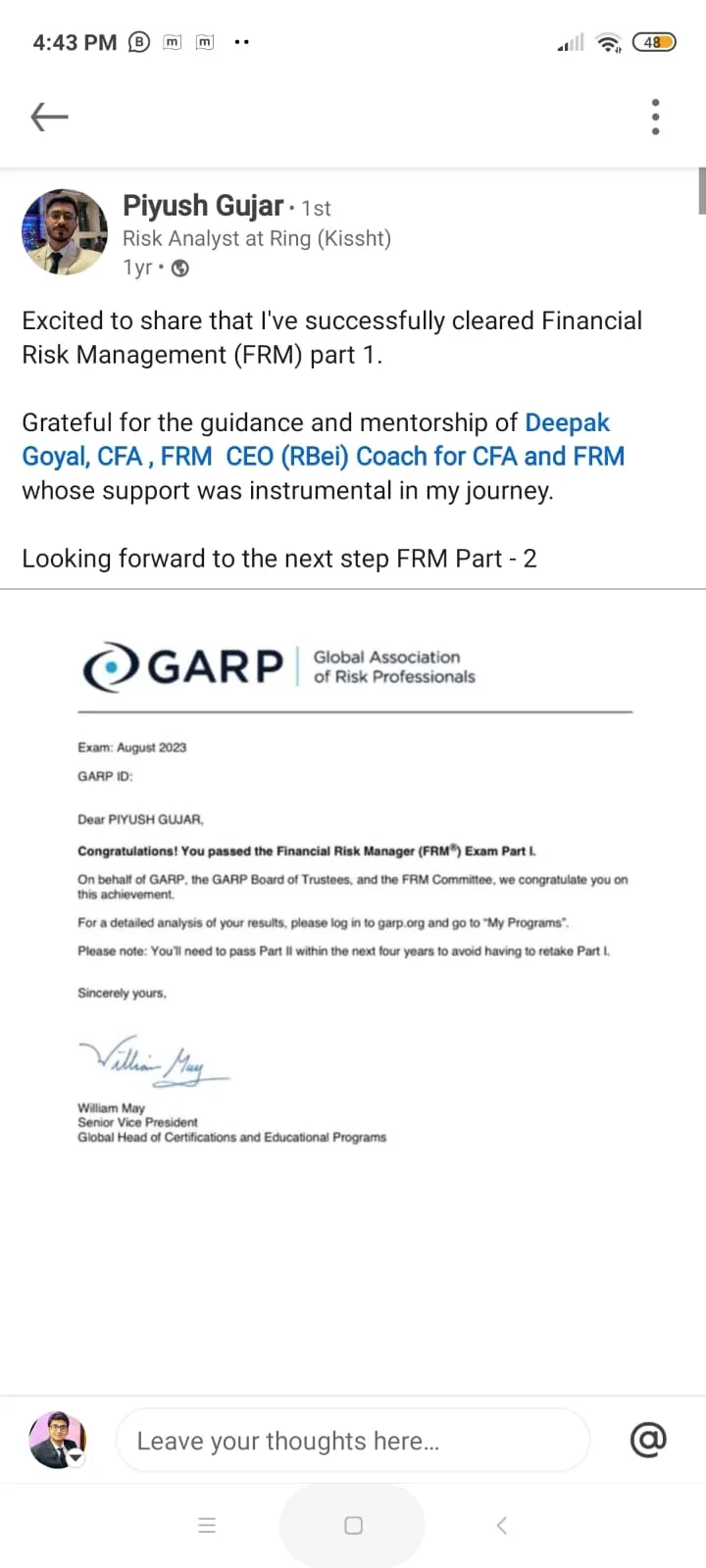
Last updated: June 2026 · Reviewed by: Deepak Goyal, CFA & FRM charterholder, founder of RBei Classes · Screenshots shared with student consent.

Alumni Success

RBei Classes Alumni Success Stories

Verified RBei Classes alumni working in risk and banking roles across India.

★★★★★
Sunil Tandon, Chief Risk Officer at Punjab & Sind Bank and RBei Classes FRM alumnus
Sunil Tandon

Chief Risk Officer, Punjab & Sind Bank

FRM cleared with RBei Classes

“I cleared the FRM exam with the help of RBei Classes. The concepts were explained so clearly that even difficult topics started making sense. The classes gave me the confidence I needed for the exam.”

Risk Management Retail Banking Operational Risk Market Risk
View LinkedIn ↗
★★★★★
Sanya Reddy, Manager at Bank of Baroda and RBei Classes FRM and CFA alumna
Sanya Reddy

Manager, Bank of Baroda

FRM Part 2 & CFA Level 2 passed

“What helped me the most was the doubt-solving support at RBei Classes. Whenever I got stuck, my questions were answered quickly and clearly. That guidance played a big role in helping me clear the FRM exam.”

Risk Management Investment Banking Credit Risk
View LinkedIn ↗
★★★★★
Payal Sharma, risk management professional and RBei Classes FRM alumna
Payal Sharma

Risk Management Professional · Ex-SBI & HSBC

FRM Part 1 cleared · CAIIB / JAIIB

“The study material provided by RBei Classes was concise and exam-focused. Instead of spending time on unnecessary content, I could focus on what really mattered for the FRM exam and eventually pass.”

Financial Risk Retail Banking Credit Risk Market Risk Liquidity Risk
View LinkedIn ↗

Ready to Clear Your CFA or FRM Exam?

Join 17,000+ students coached by Deepak Goyal, CFA & FRM Charterholder

17,000+ Students Trained
93% Pass Rate
350+ Batches Done
4.9/5 Average Rating
95% Students Placed
25+ Countries