
Key takeaways
- CFA charterholder jobs cluster in six areas: asset management, investment banking, private equity, wealth management, corporate finance and consulting.
- Common roles include portfolio manager, equity or credit research analyst, investment banking analyst, risk manager, private-equity or hedge-fund analyst, and FP&A professional.
- The career ladder typically runs Analyst → Associate → Vice President → Portfolio Manager or Chief Investment Officer.
- The CFA charter is awarded after passing three exam levels plus 4,000+ hours of relevant experience over a minimum of 36 months (Source: cfainstitute.org, verified 15 July 2026).
- RBei Classes CFA students and candidates work at firms including J.P. Morgan, Morgan Stanley, Bank of America, UBS and Deutsche Bank.
What jobs can a CFA charterholder do?
A CFA charterholder can work in portfolio management, equity and credit research, investment banking, risk management, private equity, hedge funds, corporate finance, wealth management and consulting. Analyst-level roles also hire CFA Program candidates who have cleared Level I or Level II.
Definition: A CFA charterholder is a finance professional who has passed all three levels of the CFA Program and completed CFA Institute’s 4,000+ hour work-experience requirement. CFA charterholder jobs therefore centre on investment analysis, portfolio decisions and risk management.
RBei Classes, an FRM & CFA coaching institute, sees CFA charterholder career opportunities concentrate on the buy side (asset managers, hedge funds, private equity) and the sell side (investment banks, brokerages, research houses), plus in-house finance teams at corporates. The charter signals valuation, portfolio and ethics competence that recruiters map to specific job families.
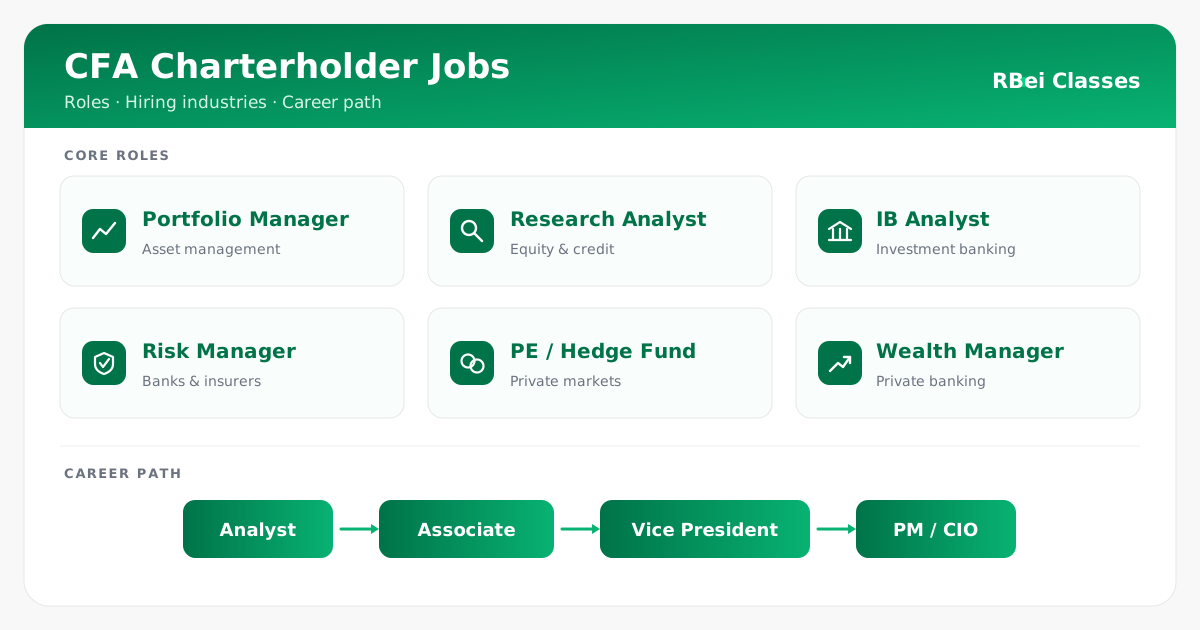
CFA charterholder jobs by role, function and hiring industry
Nine common roles for CFA charterholders and CFA Program candidates, with the typical function, entry seniority and the industries that hire.
| Role | Typical function | Entry seniority | Hiring industries |
|---|---|---|---|
| Portfolio Manager | Builds and manages investment portfolios to meet return and risk mandates. | Associate → PM | Asset management, wealth management |
| Equity / Credit Research Analyst | Analyses companies, sectors and securities to issue equity or credit views. | Analyst | Asset management, investment banking, brokerages |
| Investment Banking Analyst | Builds financial models and valuations for M&A and capital raising. | Analyst | Investment banking, boutique advisory |
| Risk Manager | Measures and controls market, credit and liquidity risk against limits. | Analyst → Manager | Banks, asset managers, insurers |
| Private Equity / Hedge Fund Analyst | Sources, screens and underwrites deals or trading strategies. | Analyst → Associate | Private equity, venture capital, hedge funds |
| Corporate Finance / FP&A Professional | Drives budgeting, forecasting, capital allocation and treasury decisions. | Analyst → Manager | Corporates, MNCs, startups |
| Wealth & Asset Management Advisor | Manages portfolios and financial plans for HNI and institutional clients. | Associate | Wealth management, private banking |
| Financial Consultant | Advises firms on valuation, strategy, restructuring and transactions. | Analyst → Consultant | Consulting, advisory, professional services |
| Chief Investment Officer | Owns the entire investment strategy and team of an institution (career endpoint). | Senior leadership (endpoint) | Asset managers, insurers, family offices, endowments |
CFA charterholder vs CFA Program candidate: access to roles
| Role tier | CFA Program candidate (Level I / II passed) | CFA charterholder (all 3 levels + experience) |
|---|---|---|
| Analyst roles | Yes — common entry point | Yes |
| Associate roles | Often, with experience | Yes |
| Portfolio manager / senior research | Rare | Common |
| Chief Investment Officer | Not typical | Eventual endpoint |
Which industries hire CFA charterholders?
CFA charterholders are hired across six core industries: asset management, investment banking, private equity and venture capital, wealth management and private banking, corporate finance, and consulting.
- Asset management
- Investment banking
- Private equity & VC
- Wealth management
- Corporate finance
- Consulting
Global banks and asset managers run large research, risk and investment teams in India, which is why RBei Classes CFA students are recruited into these industries. For the pay context behind each industry, see the RBei Classes guide to CFA salary in India.
What is the career path after earning the CFA charter?
The career path after the CFA charter typically runs Analyst → Associate → Vice President → Portfolio Manager or Chief Investment Officer, with progression driven by performance, the charter and cumulative investment experience.
- Analyst
- Associate
- Vice President
- PM / CIO
Early years are spent building models, research and risk analytics; mid-career shifts toward deal ownership, client mandates or a sleeve of a portfolio; senior roles own investment strategy end to end. To plan the exams behind this path, use the RBei Classes CFA course guide.
Is the CFA charter worth it?
For buy-side, research and risk careers the CFA charter is a strong, widely recognised signal of investment competence, and is frequently listed as preferred or required for portfolio, research and analyst roles.
The CFA charter is awarded by CFA Institute after passing three exam levels and completing 4,000+ hours of relevant work experience over a minimum of 36 months (Source: cfainstitute.org, verified 15 July 2026). Pay generally rises with each level cleared and with the completed charter; RBei Classes covers the numbers separately in its guide to CFA salary in India. To budget the journey, review CFA exam fees & registration.
Where do RBei Classes CFA students work?
RBei Classes, an FRM & CFA coaching institute, has placed CFA students and candidates at global firms including J.P. Morgan, Morgan Stanley, Bank of America, UBS and Deutsche Bank. Roles span investment banking, equity research, M&A, wealth management and fixed-income sales across Bengaluru, Mumbai, Gurugram, Pune and Ahmedabad.
| Student | Designation | Company | Location | CFA Program status |
|---|---|---|---|---|
| Priya Sharma | Investment Banking Associate | J.P. Morgan | Bengaluru | Completed the CFA Program (Levels I, II & III) |
| Rohan Kapoor | Equity Research Associate | Morgan Stanley | Gurugram | Completed the CFA Program (Levels I, II & III) |
| Arjun Malhotra | M&A Associate | Bank of America | Pune | Completed the CFA Program (Levels I, II & III) |
| Karan Bhatia | Wealth Management Associate | UBS | Mumbai | Completed the CFA Program (Levels I, II & III) |
| Rahul Desai | Fixed Income Sales Associate | Deutsche Bank | Ahmedabad | Completed the CFA Program (Levels I, II & III) |
| Aarav Mehta | Investment Banking Analyst | Goldman Sachs | Mumbai | CFA Program candidate — Level III (passed Levels I & II) |
| Sneha Verma | Portfolio Management Analyst | BlackRock | Hyderabad | CFA Program candidate — Level II (passed Level I) |
| Ananya Rao | Graduate Investment Banking Analyst | Barclays | Kolkata | CFA Program candidate — Level II (passed Level I) |
Across the institute, RBei Classes has trained 17,000+ students since 2018, with a 93% exam pass rate and a 95% placement rate. "Completed the CFA Program" means all three levels were cleared; candidates are labelled by the highest level passed.
Build your CFA charterholder career with RBei Classes
Get a free CFA course plan, mentor guidance from Deepak Goyal (CFA & FRM charterholder), and a roadmap from Level I to your target role.
Prefer to browse first? Start with RBei Classes CFA coaching.
CFA charterholder jobs — frequently asked questions
What jobs can a CFA charterholder get?
CFA charterholders commonly work as portfolio managers, equity and credit research analysts, investment banking analysts, risk managers, private equity and hedge fund analysts, corporate finance and FP&A professionals, wealth and asset managers, and financial consultants — with Chief Investment Officer as a senior endpoint.
Do you need the full CFA charter to work in these finance roles?
No. Many analyst-level roles hire CFA Program candidates who have passed Level I or Level II, while senior roles such as portfolio manager or CIO usually expect the completed charter plus relevant work experience. The charter is awarded only after all three levels and the experience requirement are met.
Which industries hire CFA charterholders in India?
CFA charterholders are hired across asset management, investment banking, private equity and venture capital, wealth management and private banking, corporate finance, and consulting. Global firms with large India teams recruit heavily for research, risk and investment roles.
What is the typical career path for a CFA charterholder?
The typical ladder runs Analyst → Associate → Vice President → Portfolio Manager or Chief Investment Officer. Progression depends on performance, the CFA charter, and cumulative buy-side or sell-side experience rather than tenure alone.
Is the CFA charter worth it for a finance career?
For most buy-side and research careers the CFA charter is a strong signal of investment competence and is often listed as preferred or required. It is awarded by CFA Institute after three exam levels and 4,000+ hours of relevant experience over a minimum of 36 months (Source: cfainstitute.org, verified 15 July 2026).
Where do RBei Classes CFA students get placed?
RBei Classes CFA students and candidates have been placed at firms including J.P. Morgan, Morgan Stanley, Bank of America, UBS, Deutsche Bank, Goldman Sachs, BlackRock and Barclays, in cities such as Bengaluru, Mumbai, Gurugram, Pune, Ahmedabad, Hyderabad and Kolkata.