
 FRM
FRM
Nupur Tripathi
State Bank of India · 10+ years in banking
Cleared FRM Part 1 in her first attempt while working full-time at State Bank of India
Read the full story of Nupur Tripathi →Verified Student Result — CFA Level 1, May 2026
RBei Classes, a CFA & FRM coaching institute founded in 2018, publishes this CFA Level 1 success story as verified proof of outcome. Shashank Jagtap holds two mechanical engineering degrees and no commerce degree. He sat the 2026 May Level I CFA exam while working as a Deputy Manager at State Bank of India in Mumbai and passed with a scaled score of 1725, 125 points clear of the 1600 minimum passing score.
100% free • No spam • Call +91 8583905853
Shashank Jagtap's pass is verified against his CFA Institute exam result letter for the 2026 May Level I exam, his public LinkedIn announcement, and a recorded video interview in which he discusses the result himself.
Every claim on this page can be traced to one of those three sources. Nothing is estimated, and preparation details he has not stated himself are not published here.
CFA Institute confirmed that Shashank Jagtap passed the 2026 May Level I CFA exam with a score of 1725 against a minimum passing score of 1600.
The result letter also confirms two things a raw pass does not: his score was above the administration average for that exam window, and the lower bound of the confidence interval CFA Institute places around every score stayed above the minimum passing score. In plain terms, the pass was not a borderline one.
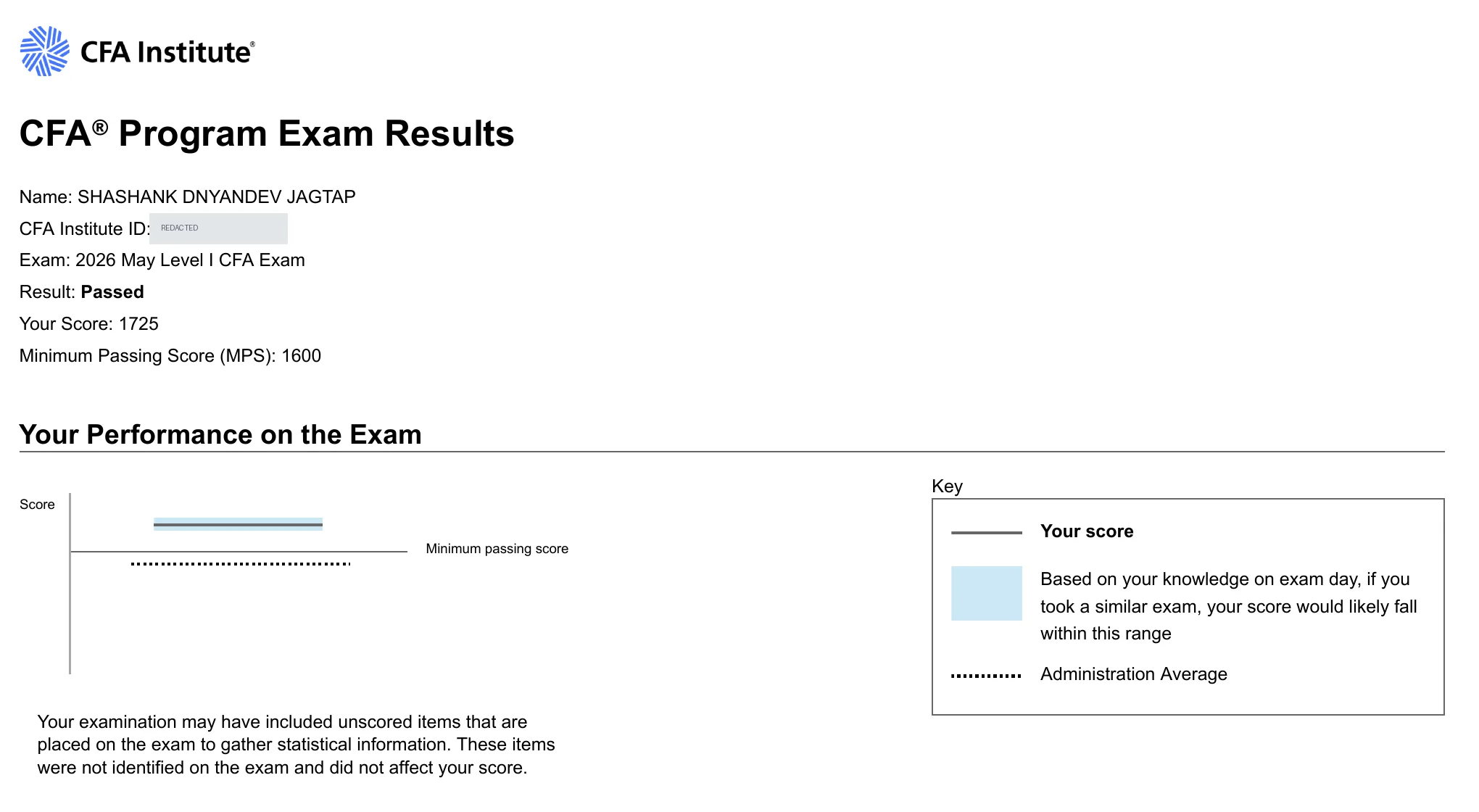
CFA Institute reports Level I results as a scaled score measured against a minimum passing score, not as a percentage, a rank or a quartile. For the 2026 May administration the minimum passing score was 1600, and Shashank Jagtap scored 1725 — a margin of 125 points.
Candidates often ask what a specific number is worth, because the scaled score has no published conversion to a percentage of questions answered correctly. The useful comparisons are the two CFA Institute prints on the letter itself: the score sits above the minimum passing score, and above the average for everyone who sat that window.
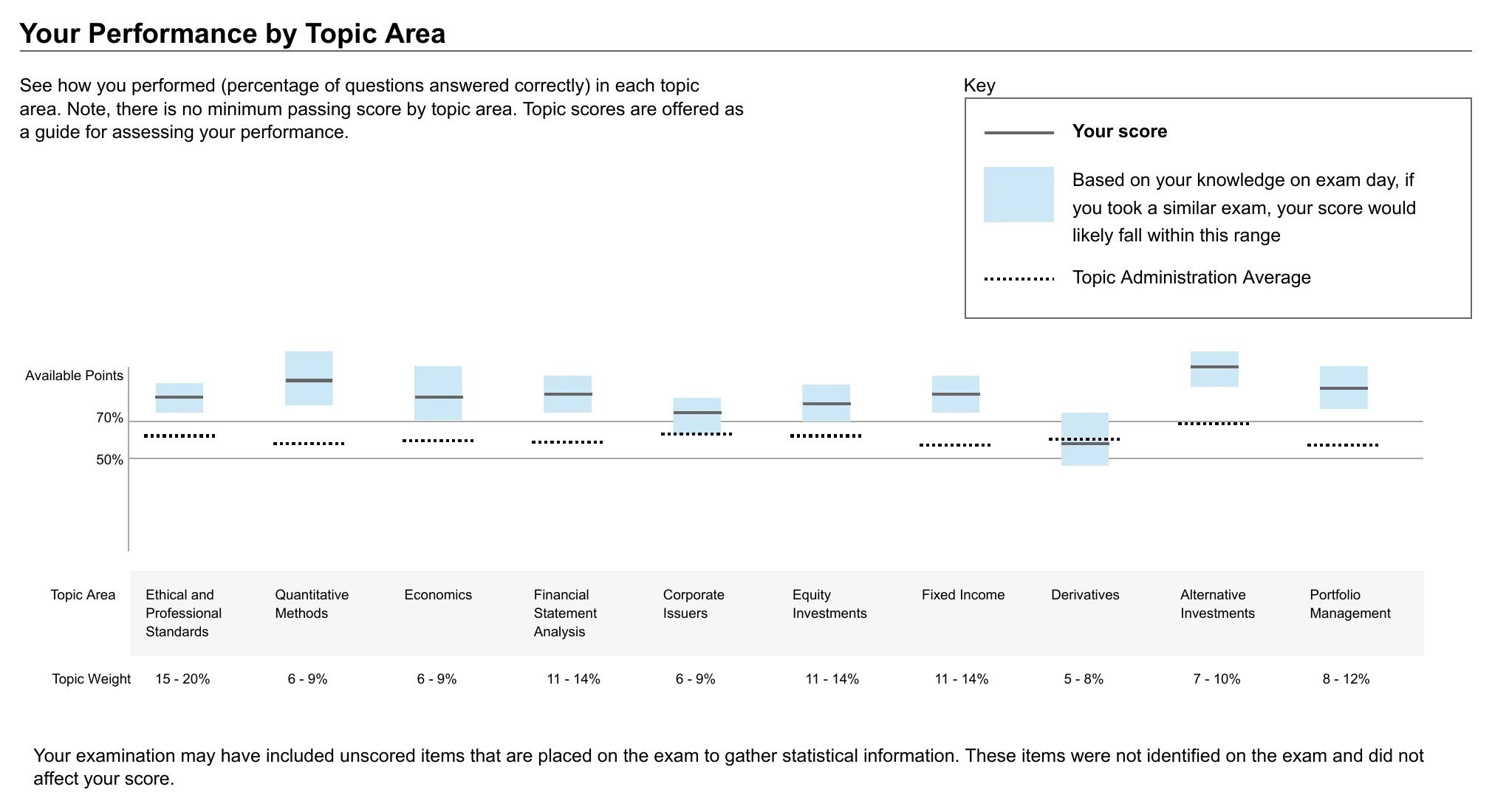
The second page of the result letter breaks performance down by topic area. Shashank Jagtap scored above 70% of available points in nine of the ten Level I topics: Ethical and Professional Standards, Quantitative Methods, Economics, Financial Statement Analysis, Corporate Issuers, Equity Investments, Fixed Income, Alternative Investments and Portfolio Management. Derivatives was the exception — between 50% and 70% of available points, and below the topic administration average.
This is worth stating plainly rather than hiding, because it answers a question a lot of candidates carry into exam day. CFA Institute is explicit that there is no minimum passing score by topic area. A weak topic does not fail you on its own; it is absorbed by the overall scaled score. Derivatives also carries one of the smallest weights on the Level I exam, at 5–8%.
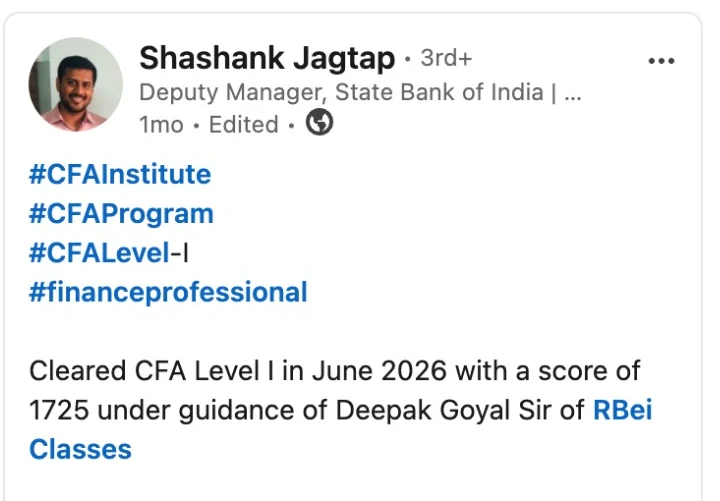
Shashank Jagtap is a Deputy Manager at State Bank of India in Mumbai and a mechanical engineering postgraduate, who passed the 2026 May Level I CFA exam after preparing with RBei Classes.
His public profile lists his SBI work across several credit portfolios, beginning as a Credit Support Officer at an SME branch. That is the part of a bank where financial statement analysis is a daily working tool rather than a syllabus topic — which shows in a Financial Statement Analysis score above 70% in a subject that carries 11–14% of the Level I exam.
The rest of the profile cuts the other way. Two mechanical engineering degrees, taken between 2007 and 2014, are not a finance education. Everything from ethics to derivatives pricing had to be learned from a standing start, alongside a full-time job.
Shashank Jagtap prepared with RBei Classes and credited Deepak Goyal, CFA & FRM charterholder, by name in his public post announcing the result.
“Cleared CFA Level I in June 2026 with a score of 1725 under guidance of Deepak Goyal Sir of RBei Classes”
— Shashank Jagtap, Deputy Manager, State Bank of India · on LinkedIn
His post refers to clearing Level I in June 2026 while the result letter is headed 2026 May Level I CFA Exam. Both are accurate: CFA Institute names the exam after its administration window and releases results to candidates a few weeks later, so a May exam produces a June result.
Study hours, mock counts and the sequence he followed are covered in his own words in the video interview below. RBei Classes does not publish preparation figures a student has not stated directly.
In this interview with RBei Classes, Shashank Jagtap talks through preparing for CFA Level 1 from an engineering background while working full time at State Bank of India.

Video published on the RBei Classes YouTube channel. Watch it directly at youtube.com/watch?v=gXhaOi9Cah8.
Each answer below is drawn from Shashank Jagtap's CFA Institute result letter, his public profile, or published CFA Institute guidance. Where a question depends on information he has not made public, that is stated rather than filled in.
Shashank Jagtap finished 125 scaled points above the minimum passing score of 1600. CFA Institute publishes a confidence interval around every score to reflect the fact that a different set of questions on the same day would have produced a slightly different number. On his letter, the whole of that interval stayed above the minimum passing score.
That is the practical definition of a safe pass: not the size of the gap on its own, but a gap wide enough that the uncertainty band never crosses the line.
It does both, in predictable places. Quantitative Methods and the numerical parts of Fixed Income and Portfolio Management reward comfort with algebra, probability and discounting, which an M.Tech in thermal sciences supplies. Ethical and Professional Standards — the single largest topic at 15–20% — rewards none of it, and Financial Statement Analysis assumes an accounting vocabulary no engineering course teaches.
Shashank Jagtap scored above 70% in all three of those areas. The engineering background is not the reason for the result, but it did not stand in the way of it either.
Yes. Derivatives was his weakest area, between 50% and 70% of available points and below the average for that topic, and he still passed 125 points clear. CFA Institute states directly on the result letter that there is no minimum passing score by topic area.
The planning consequence matters more than the reassurance. Derivatives carries 5–8% of Level I. Ethics carries 15–20%, and Financial Statement Analysis, Equity Investments and Fixed Income each carry 11–14%. Time spent rescuing a small-weight topic at the expense of a large-weight one is a bad trade, and the topic weights are printed in the CFA Institute curriculum before you start.
On this evidence, yes. Shashank Jagtap has been at State Bank of India since January 2021 and sat the exam as a serving Deputy Manager in Mumbai. He is also not the only verified SBI result published here — Nupur Tripathi cleared FRM Part 1 in her first attempt while working at SBI in Hyderabad.
Bank roles bring a specific constraint rather than a general one: month-end, quarter-end and audit periods are immovable, so a study plan that assumes even weekly hours will break. The formats that survive it are recorded lectures that can be replayed and doubt-clearing that can be scheduled outside branch hours.
CFA Institute candidate surveys have historically put average Level I preparation in the region of 300 hours, and the programme is designed around roughly that commitment per level. Shashank Jagtap has not published his own hour count, and RBei Classes does not print a figure a student has not stated. His preparation timeline is discussed in his own words in the video interview above.
Every figure below comes from his CFA Institute result letter or his public professional profile. Nothing is estimated or inferred.
| Factor | Shashank Jagtap, May 2026 | Source |
|---|---|---|
| Exam | 2026 May Level I CFA exam | CFA Institute result letter |
| Result | Passed | CFA Institute result letter |
| Scaled score | 1725 | CFA Institute result letter |
| Minimum passing score | 1600 | CFA Institute result letter |
| Margin above MPS | 125 scaled points | Calculated from the result letter |
| Against the cohort | Above the administration average | CFA Institute result letter |
| Topics above 70% of points | 9 of 10 — Ethics, Quantitative Methods, Economics, Financial Statement Analysis, Corporate Issuers, Equity, Fixed Income, Alternative Investments, Portfolio Management | CFA Institute result letter, page 2 |
| Weakest topic | Derivatives — between 50% and 70% of points, below topic average | CFA Institute result letter, page 2 |
| Coaching | RBei Classes, mentored by Deepak Goyal, CFA & FRM | His public LinkedIn post |
| Employment during preparation | Full-time, Deputy Manager, State Bank of India, Mumbai | Public professional profile |
| Education | B.E. Mechanical Engineering, University of Mumbai; M.Tech Mechanical Engineering (Thermal Sciences), NIT Calicut | Public professional profile |
CFA Institute sets the minimum passing score for each administration and does not publish a conversion between scaled scores and the percentage of questions answered correctly. Candidates should confirm current scoring guidance at cfainstitute.org.
Yes — Shashank Jagtap passed the 2026 May Level I CFA exam with a 1725 score holding two mechanical engineering degrees and no commerce qualification, while working full time at State Bank of India.
CFA Institute does not require a finance background to enrol; the entry requirement is a bachelor's degree, final-year student status, or a qualifying combination of work experience. What a non-commerce candidate actually needs is a schedule weighted towards the topics with no prior exposure — accounting vocabulary first, ethics treated as a subject to be studied rather than reasoned through — and enough repetition on those to clear the same bar as a commerce graduate.
The starting point for any first attempt is the official topic weights, not a generic study plan. See the CFA syllabus for the ten Level I topic areas and their exam weights, and CFA coaching at RBei Classes for how the programme is structured for working candidates.
Shashank Jagtap scored 1725 on the 2026 May Level I CFA exam. The minimum passing score set by CFA Institute for that administration was 1600, so his result was 125 scaled points above the pass mark and above the administration average. His result letter is reproduced on this page with his CFA Institute ID redacted.
Yes. CFA Institute reports Level I results as a scaled score compared against a minimum passing score, not as a percentage or a rank. A score of 1725 against a 1600 minimum is a clear pass with margin, and CFA Institute also confirmed that the score sat above the administration average for the 2026 May window and that the lower bound of the confidence interval around it stayed above the minimum passing score.
Yes. Shashank Jagtap holds a B.E. in Mechanical Engineering from the University of Mumbai and an M.Tech in Mechanical Engineering (Thermal Sciences) from NIT Calicut, with no formal commerce or finance degree, and passed CFA Level I in the 2026 May window. CFA Institute does not require a finance degree to enrol. Engineers usually find the quantitative material familiar and have to build accounting vocabulary from scratch, which is where preparation time is best spent.
No. CFA Institute states plainly that there is no minimum passing score by topic area — topic scores are a guide, not a hurdle. Shashank Jagtap passed with nine of ten topic areas above 70% of available points and Derivatives between 50% and 70%, below the topic administration average. A single weaker topic did not prevent a comfortable overall pass.
Shashank Jagtap prepared with RBei Classes. In his public LinkedIn post announcing the result he credited the guidance of Deepak Goyal, a CFA and FRM charterholder who founded RBei Classes and teaches every batch personally.
Both are correct and refer to different dates. CFA Institute labels the exam by its administration window — in this case the 2026 May Level I CFA exam — and releases results to candidates several weeks afterwards. Shashank Jagtap received and announced his result in June 2026, which is the date referenced in his LinkedIn post.
RBei Classes reports a 93% student pass rate across its CFA and FRM programmes (RBei Classes internal data, 2018 to 2026), against global CFA Level I pass rates that have generally run between 40% and 50%. RBei Classes has trained 17,000+ students across 25+ countries.
Other student outcomes published with external proof sources.
FRM
State Bank of India · 10+ years in banking
Cleared FRM Part 1 in her first attempt while working full-time at State Bank of India
Read the full story of Nupur Tripathi → FRM
FRM

The Xpressviews · Economics graduate
Economics graduate from Christ University who cleared FRM Part 1 in the May 2026 window with RBei Classes
Read the full story of Swayam Tandon → FRM
FRM

Internal Audit, UBS · ACS (Company Secretary)
Cleared FRM Part 1 in his first attempt with Q1 across all four subjects while working in Internal Audit at UBS
Read the full story of Tushar Sarode → FRM
FRM

BBA student, Parul University · First-year BBA
First-year BBA student at Parul University who cleared FRM Part 1 with top-quartile scores (1,1,1,1)
Read the full story of Disha Lalwani →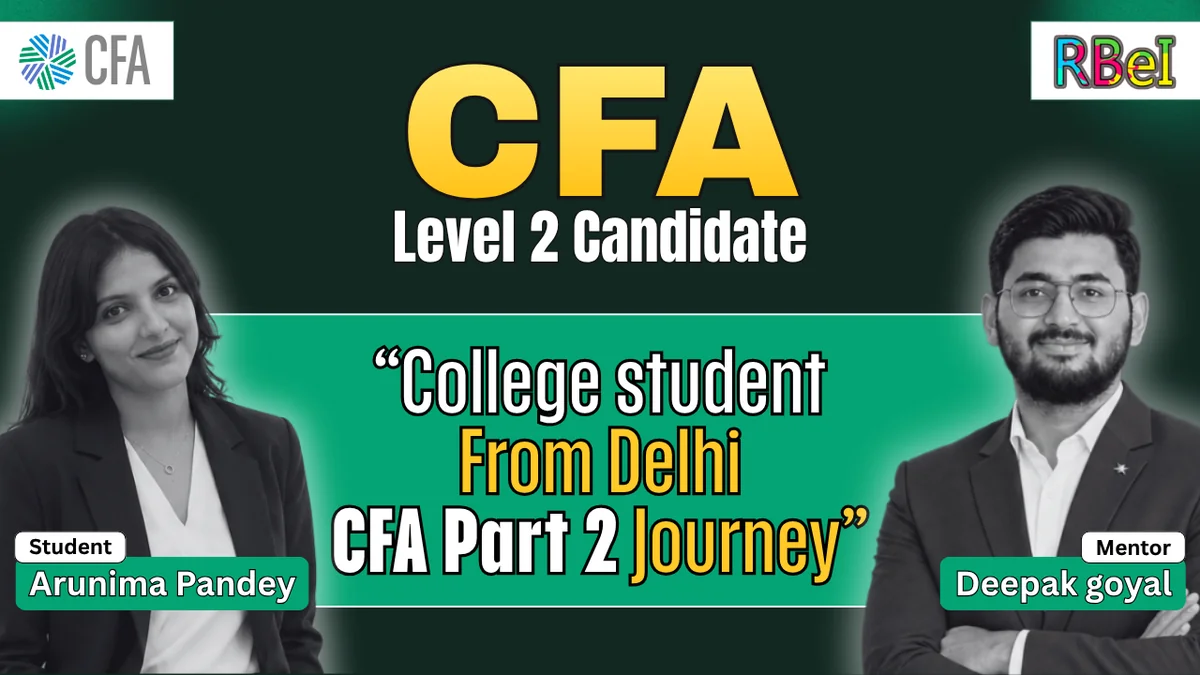 CFA
CFA
Undergraduate student; Advisory Board, 180 Degrees Consulting KN, Kamala Nehru College · Self-study · former RBei Data Analytics Intern
Delhi University undergraduate at Kamala Nehru College who cleared CFA Level 1 through self-study (not RBei coaching) and is now a CFA Level 2 candidate; former RBei Data Analytics Intern
Read the full story of Arunima Pandey → FRM
FRM

Undergraduate student; CFA Level 3 Candidate, Narsee Monjee College of Commerce and Economics · NMCCE’26 · CFA Level 3 Candidate
CFA Level 3 Candidate and NMCCE’26 student in Mumbai who cleared FRM Part 1 in the Nov 2025 window with RBei Classes
Read the full story of Panav Kotecha →Browse the full filterable list on RBei Classes student results.
RBei Classes runs CFA Level 1, 2 and 3 programmes built for working professionals and candidates from non-commerce backgrounds, taught personally by Deepak Goyal, CFA & FRM charterholder. 93% student pass rate (RBei Classes internal data, 2018–2026).